The latest edition of our Library magazine, The Submarine, has just been published, and can be read above via Issuu (click once for a closer look, click again for still closer, and use the arrows for navigation).
This time: interesting comments by the editor and Librarian, Mr McConville, about digital technology; a report by Seyilogo Braithwaite on the visit by novelist Paul Murray; news of the forthcoming Arts Week; Gabriel Chisholm on 'Snakes', book reviews by Nyla Jamieson, Dr Bannister and Mr Swift; Valentina Ascencio Munoz on the benefits of literature; Blanaid Sheeran on the Book Club set up by Mr Jameson, and more.
The theme for this year's Junior Poetry Prize is 'The Senses' (sight, hearing, smell, touch, taste).
Any interpretation of this theme is welcome. Poems should be twelve lines or more, and each entrant may enter as many poems as he/she wishes. Email your entries to Ms Smith, or hand them to your English teacher, by Thursday 26th March (the day before the end of term).
Watch ShowMe analyses of-
a) Gatsby falls in love with Daisy (p.128) -
http://www.sccenglish.ie/2012/03/great-gatsby-13-gatsby-falls-in-love.html
b) Nick and Gatsby’s last meeting (p.133) -
http://www.sccenglish.ie/2012/03/great-gatsby-14-nick-and-gatsbys-last.html
- Explain how Gatsby ‘found that he had committed himself to the following of a grail’ (p.129) in pursuing Daisy.
- What is the significance of the weather in this chapter? Give details.
- What are Nick’s feelings on leaving Gatsby (refer also to his call from Jordan Baker)?
- (p.139) What are the most significant things about the description of Gatsby’s death?
- If you had to choose one short passage (c.20 lines) as the key one in this chapter, what would it be? Why? Key quotations?
- Three other useful quotations from the chapter not used already.
The Poem for Ireland microsite from RTE is nicely done, with the texts of the shortlisted poems, comments on them, background, recitals from Poetry Aloud finalists, and the ability to upload material, including performances of the poems. And, of course, the facility to vote for your favourite poem.
Here's Patrick Kavanagh's 'A Christmas Childhood'.
A reminder to TY pupils that a poem can be part of this year's Work Portfolio (possibly a response to one of those on the shortlist).
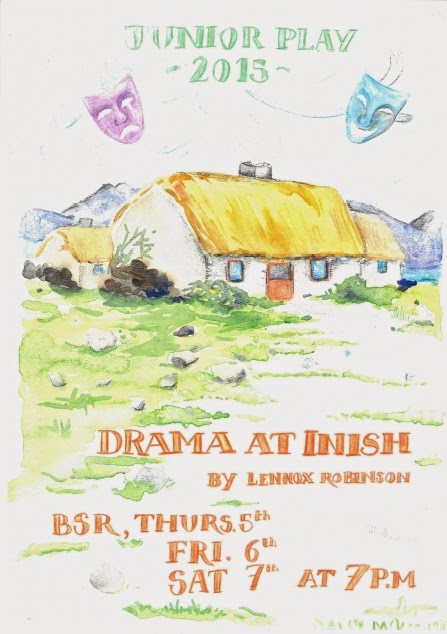 |
| Poster by Daisy McKeever |
The 2015 Junior Play is on this weekend, on Friday and Saturday at 7pm in the Big Schoolroom. It's Lennox Robinson's old favourite, Drama at Inish (last produced here in 2001 as the Senior Play). All parents and their guests are welcome.
Here is the programme:
"Everyone needs some entertainment while on holidays but when the de la Mare Reparatory Company comes to Inish for the summer season no one expects the response they will engender in the locals…
Lennox Robinson is a much-loved Irish playwright who was director of the Abbey theatre for many years. Drama at Inish was first performed in 1933. It has been produced in America several times under the title Is Life Worth Living?
There are three Acts in the play, with two scenes in Act II. The action takes place in a private sitting room of the Seaview Hotel, Inish.
ACT I: A July morning.
ACT II: Scene i & scene ii – Early evening, ten days later.
ACT III: A week later, morning.
The Players
John Twohig, proprietor of the Seaview Hotel: Nevin McCone
Annie Twohig, his wife: Nicole Dickerson
Lizzie, his sister: Alexandra Murray-Donaldson
Eddie Twohig, his son: James O’Connor
Peter Hurley, the local T.D.: Douglas Boyd Crotty
Christine Lambert: Lena Pirlet
Hector de la Mare, an actor: Ross Magill
Constance Constantia, his wife: Emmanuella Ejase-Tobrise
Helena: Grace Goulding
Michael: Max Hillery
Jean Hegarty, a report: Aniko Szkendy
Deirdre Mooney, a Guard: Isabelle Townshend
Slattery: Catherine Butt
Production Credits
Make-up: Helena Gromotka, Ciana Taylor, Marie-Sophie Stumm
Poster: Daisy McKeever
Willing Helpers: MJ McCullough, Robbie McDonald
Costumes: Karen Hennessey, Evan Jameson & Ronan Swift
Lights, Sound, Set, Props and Direction: Evan Jameson & Ronan Swift
Watch ShowMe analysis of
‘Daisy and Gatsby meet again’ -
http://www.sccenglish.ie/2012/02/great-gatsby-7-gatsby-daisy-meet-again.html
- What is the nature of the meeting between Gatsby and Daisy in Nick’s house (before Nick leaves)? (Heinemann pp74-76).
- What is the nature of the meeting between Gatsby and Daisy when they move to Gatsby’s house?
- What is the significance of the green light at the end of the dock? (refer to the rest of the novel, too).
- In what ways are dreams important in the novel?
- If you had to choose one short passage (c.20 lines) as the key one in this chapter, what would it be? Why? Key quotations?
- Three other useful quotations from the chapter not used already.
(no ShowMe analyses from this Chapter: the next one will be from Chapter 5, ‘Daisy and Gatsby meet again’ - http://www.sccenglish.ie/2012/02/great-gatsby-7-gatsby-daisy-meet-again.html )
- What are Nick’s reactions to the stories Gatsby tells him about his past? [pp 57-59, Heinemann]
- Three useful quotations from those pages (above).
- Significant details about Meyer Wolfsheim.
- What is the significance of the references to the World Series fixing of 1919?
- What do we (and Nick) learn from Jordan Baker about the origins of Daisy and Gatsby’s relationship?
- If you had to choose one short passage (c.20 lines) as the key one in this chapter, what would it be? Why? Key quotations?
The first Transition Year Extended Essay we are posting from this year's work is by Seyilogo Braithwaite (for which she received a Distinction) and is on the subject of racism in three novels - Harper Lee's To Kill a Mockingbird, Noughts and Crosses by Malorie Blackman and The Help by Kathryn Stockett.
Seyilogo writes:
The topic for my extended essay is racism. What led me to this topic is the trivial amount of racism I have encountered while abroad. I remember reading these books and thinking to myself how far society has progressed since the times these books were set. As a young black woman in a white country, I have only experienced racism twice which upset me at the time but reading these books has made me realise that my experiences are nothing compared to those of coloured people in the past. The theme I have chosen shows how three different authors portray the common theme of racism which I found very fascinating.
Read her full essay here.
Here we go again: our annual round-up of Books of the Year
features in the press and on some blogs. This list will be regularly updated in the coming weeks. Some of
the lists are specifically for children or young adults, but plenty
aren't.
[updated 5.1.15].
Previous lists are here: 2010, 2011, 2012, 2013.
- The Irish Times has lots of authors' choices, on separate pages. Rory O'Neill, aka Panti Bliss, goes for one of our own choices last year, Damien Barr's Maggie and Me. Joseph O'Connor pinpoints the exciting talent of Davy Byrnes Short Story Award winner, Sara Baume. There is also a list of best children's and young adults' books, compiled by the ever-excellent Robert Dunbar.
- The Irish Times's Eileen Battersby is a rather erratic critic, but there is still plenty of interest in her selection of the year. She calls Richard Flanagan's The Narrow Road to the Deep North 'one of the strongest-ever Booker winners' (though some readers will find the love and sex scenes cringe-making).
- The Irish Independent has Sarah Webb's selection of best children's books, from 2-5 to Young Adult. Roddy Doyle's Brilliant makes the list. John Spain compiles the best non-fiction list, concentrating on history, including Roy Foster's widely-acclaimed Vivid Faces. John Boland does the fiction list, mentioning how bulky many novels are nowadays, and giving pride of place to Colin Barrett's award-winning short stories Young Skins.
- In the Telegraph, Tim Martin briskly rushes past the usual suspects to an interesting selection of the best fiction of the year, such as Jenny Offill's Dept of Speculation and Paul Kingsnorth's challenging The Wake. He also recommends 80 Days, "a collaboration for iPad between Profile Books and the game company Inkle, which revives Jules Verne’s Around the World in 80 Days as a steampunk choose-your-own adventure in which you play Passepartout. Is it a game? Is it a story? Both, really. And a delight." The Telegraph also has Best Photography and Art, Best Cookbooks, Best Poetry (starting with Kevin Powers's Iraq War poems), Best Biographies (including James Booth's much-reviewed book on Philip Larkin which 'restores some balance and warmth'.)
- School Library Journal: best Young Adult books, and also non-fiction, middle grade and picture books (such as Byron Barton's My Bus) - an informed selection all round.
- The Guardian's annual feature comes in two parts here and here: writers such as Mary Beard (Colin Jones's The Smile Revolution), Josh Cohen (Marion Coutts's harrowing The Iceberg) and Mark Lawson (the late great Seamus Heaney's New Selected Poems 1988-2013) make their choices. There are separate lists for best art books, best fiction and best photography books. The full collection is here. Nicholas Lezard often spots gems: here's his best paperback list. Publishers' hits and misses is an annual good read, as is the reader-selection.
- Here are Guardian Australia's picks, with a predictable picture.
- The annual 100 Notable Books from The New York Times offers Lorrie Moore's latest short stories, Bark, Jenny Offill (on many lists) and Marilynn Robinson's widely-noted Lila, the final book in a loose trilogy. There's also Notable Children's Books and What's the Best Book, New or Old, You've Read this Year?
- Another from the NYT is an interactive of the best covers of the year - some superb design here.
- The New Yorker has Nine Great Poetry Books of 2014, and more generally their contributors' Best Books of 2014, such as Elena Ferrante's Naples novels, recommended by Sarah Larson.
- Maria Popova on the extraordinary Brain Pickings site has the best children's books of the year and best science books, among others.
- Printers' Row from the Chicago Tribune has a fine selection of Best Books of 2014, including the superb doctor/writer Atul Gawande with Being Mortal (many of his previous books have interesting ideas for education, too) and Irish writer Eimear McBride's A Girl is a Half-Formed Thing (also not an easy read, this time for stylistic reasons).
- The Herald in Scotland has selections from reviewers and staff writers, starting with a book set in a school, Megan Abbott's The Fever ('dripping with tension'). Iain MacWhirter chooses The Circle, by Dave Eggers (out last year but now in paperback), a thought-provoking treatment of the implications of a Facebook or Google becoming yet more powerful.
- The London Independent has a whole battery of lists in all genres; to pluck out one, the crime list mentions reissues of the great Patricia Highsmith, such as Those Who Walk Away.
- Melanie McDonough in the Spectator presents her best children's books of the year. Erich Kästner's The Flying Classroom and The Parent Trap are here in new editions from Pushkin, translated by the great Anthea Bell.
- The Financial Times has a review of the literary year by Lorien Kite, followed by choices by writers such as Martin Amis and Karl Ove Knausgaard (both of whom feature in many lists).
- There's a selection from the TLS feature here. Andrew Motion goes for the intruiging work of the 'forgotten' poet Rosemary Tonks.
- The StarTribune's critics select their favourite books, including Dept of Speculation (as per our illustration). Richard McGuire's Here sounds intriguing - great American cover, too.
- Bookpage has the 10 best mysteries and thrillers of 2014, such as Tom Rob Smith's The Farm.
- Time magazine's best photography books of the year includes lots of vivid images.
- Huffington Post's Best Books of 2014 has more substantial entries than most, garnered from reviews. Rebecca Mead's book about one of the greatest of all novels, Eliot's Middlemarch, is 'lovely' and 'illuminating'. The Unspeakable by Meghan Dunn (good cover) looks interesting. There is also a Young Adult list.
- The Washington Post's 10 Best Books of 2014 mentions Sarah Waters's widely-mentioned novel Paying Guests, sibilantly telling us that we will 'surrender to the smooth assuredness of Sarah Waters's silken prose.'
- Slate's Best Books of 2014 (including a feature on overlooked books) includes Lorrie Moore's latest short stories in Bark (at times maddening but often heart-piercing).
- The Daily Mail's selection is predictable enough - no harm in starting with Colm Toibin's excellent Nora Webster, though.
- The Sydney Morning Herald gathers Australian writers' choices, including Michelle de Krestner going for the always excellent Dalmon Galgut's Arctic Summer, about E.M.Forster in India.
- History Today has an informed selection.
- NPR in America features Maureen Corrigan's selection of 12 from 2014, including Ben Lerner's 10:04, which also pops up in some other lists.
- The Wall Street Journal's selection is neatly presented in graphic form, a master list of those mentioned elsewhere (Sarah Waters comes out top in fiction).
- Bustle has a good selection of 25 books, including the always interesting Lydia Davis's latest collection, Can't and Won't.
- The Atlantic magazine has The Best Book I Read This Year (whenever it was published). Editor Sophie Gilbert goes for the late Kent Haruf's Plainsong.
- There's a good list in Deutsche Welle of the 10 Must-Read German Books of 2014, including two by Andreas Maier, who is making big waves outside Germany now.
- The Mother Jones staff selection has some of the usual suspects. Saga Deluxe Edition, Volume 1, by Brian K.Vaughan and Fiona Staples is a bit different.
- The Seattle Times goes for a top 35. The excellent Richard Ford is here, with the terribly-named Let Me Be Frank With You.
- In the L.A. Times, David L. Ulin reviews the year in books, starting with the 'poster child' of 'incidental things', Karl Ove Knausgaard.
- In The Australian, plenty of authors and critics select their best books of the year, including Bruce Beresford calling Knausgaard's A Death in the Family 'a masterpiece'.
- O Magazine from the Oprah Winfrey stable has an editors' selection. The 'must-read for our generation' is Roxane Gay's essay collection Bad Feminist.
- From a Canadian perspective, the Globe and Mail's feature has a series of snappy recommendations.
- Blogger John Self's selection from 2014 concludes with Dept of Speculation (pictured at the top) as his favourite new book.
The recent Senior Play production of The Importance of Being Earnest provided great pleasure for all its audiences over three nights in the Big Schoolroom. One of the most purely pleasurable of comedies, Earnest has had regular productions over the years here; this latest one was directed with thoughtfulness and close attention to detail by Mr Tristan Clarke and Mr Ronan Swift. It is not an easy play to put on for pupils: its wordiness can be hard-going in clumsy hands. At its best, though, the dialogue fizzes from witticism to witticism, and warms the audience along the way with its easily-worn brilliance.
That brilliance was captured well by at the start of the evening by John Clarke and Harvey McCone, as Algernon Moncrieff and Jack Worthing respectively. Both were at ease on the stage; both made the audience feel at ease. Jack's part spans most of the play, and Harvey's acting was pleasingly light of foot. Perhaps the biggest reach for anyone on this cast of twenty-first century teenagers was for Darcy Maule, playing the domineering Lady Bracknell. She did very well, with a good sense of comic timing, and, impressively, she managed that line (the handbag one) without either aping her famous predecessors or pushing unnaturally for an original angle. Melissa Halpenny also did well in her first role on the Columban stage as Lady Bracknell's daughter, Gwendolen.
Best of all in this production was Phoebe Coulter as Cecily. Appearing for the first time on the Columban stage in a major role, she played the part with a beautiful lightness of touch, micro-expressions flitting over her face vividly, with a perfect sense of comic timing (nice use of the watering can). The latter part of the play was also adorned with a different kind of comedy, in Samuel Clarke's doddery Canon Chasuble, chasing after Louvisa Karlsson-Smythe's Miss Prism with nervous eagerness.
The fine cast was completed by butlers Oisin Large and Nikolaus Eggers, who drew a round of applause for the switch of sets (a pulled back curtain on a wire).
A demanding audience, few of whom knew the play beforehand, were sent happily out of the Big Schoolroom by the pleasing ending, after a couple of hours' beautifully-achieved drama.
[At the top of this post, interviews with Mr Swift and the cast put together by Dr Bannister. Here, see excellent photos of the production taken by Liz Lawrence].
The second novel for discussion by the Book Club who meet in the Library is Sarah Winman's When God Was a Rabbit. Plenty of time to get a copy and read it before March (post-exams) when the next meeting will take place, again in the Library.
An excellent addition to web resources on the poet Eavan Boland (often on the Leaving Certificate course), is a new site called A Poet's Dublin, created by the Illuminations gallery at Maynooth University, as part of an exhibition of the poet's work and photography. There are audio recordings and commentaries by the poet, and also critical commentaries by other writers/critics.
Here's her beautiful poem 'The Pomegranate'.
We've add the site to our list of helpful resources on Boland.
Another post summarising useful resources for the Leaving Certificate, which will be updated every now and then (see our Hamlet page here), this time on the Irish poet Eavan Boland.
- Our own podcast on her poem 'This Moment' [8.32 minutes].
- The text of 'The Pomegranate'.
- A Poet's Dublin: site from Maynooth University with recordings and commentaries.
- An interview with Elizabeth Schmidt.
- The Skoool.ie page: brief biography, and commentary.
- The Wikipedia page, with plenty of links at the bottom (the usual cautionary note about facts on Wikipedia...)
Scoilnet extract from Object Lessons on being a female Irish poet, with questionsUS Colleges TV Video of reading and talk by Boland ['The Pomegranate' from 6:20]- Reading at Cornell University [YouTube, starts with Boland at 15:00]
[updated September 2016. Some dead links]


