Showing posts with label Images in Poetry. Show all posts

Thursday, February 09, 2012

'Ophelia Among the Flowers'

Here's the latest poem from the Images in Poetry module in Transition Year. Click here for more. This time, Harry Fitzgibbon has written a short poem prompted by Odilon Redon's 'Ophelia Among the Flowers':-

The red rose full with blood,
The blue flower of the butterfly,
The lady lying down asleep.
 
Dead or alive
In the water of her own dream.
 
The sky is full of yellow gold-lined cloud.

Tuesday, February 07, 2012

Petrarchan Sonnet for Palestine

One of the modules in our Transition Year course is run by Ms Smith, Images in Poetry: it has produced many fine poems in the past, prompted by different paintings and photographs. Here is the first one from this year's course, written by Helene Peters and prompted by Banksy's 'Palestine':-

Waves are breaking under the pure blue sky
in this perfect paradise of a land.
The beach is wide, the palms grow high.
There are children with a shovel in their hand.
The only noise the crushing of the blue.
Far away a singing bird.
This feeling of peace and freedom is so true.
No humans, no fights, nothing to be heard.

Reality, however, is grey on grey.
Fences surrounding the place.
A gunshot. You can hear a scream.
The peace and freedom fade away.
There's just the battle of religion and race.
This lonely island - just a wishing dream.

Saturday, May 15, 2010

Images in Poetry

Yesterday we reported on Olivia Plunket's success in the Teaching English poetry competition with her poem 'Judith and Holofernes' (last year Thomas Emmet's 'The Old Guitarist' was Highly Commended in the same competition). A series of poems from the Images in Art TY module will feature in our forthcoming book, and here now Ms Smith explains the purpose and method behind this exciting feature of our Transition Year:-

Innate curiosity is a wonderful thing. John Berger, in his iconic little book of 1972, Ways of Seeing, celebrates this and aims to ‘start a process of questioning’. In light of the fact that all productive lessons have an aim, Berger’s has been adopted for the Transition Year Images in Poetry module. In this module pupils explore the link between images and poetry.

To begin, a selection of famous paintings is studied alongside corresponding poems by well-known poets. Questions about the poets’ intentions are posed: What might the writer wish to capture, achieve or develop? Why do they choose particular forms? Do the poems sit comfortably next to the images? And are they obliged to do so or not?

The next stage sees the pupils looking at photographs and paintings of their finding and questioning them; this is the most important part of the process and happens readily for most, even the sceptics. They might ask: Why has this been framed (it’s awful!)? What is happening just beyond where the field is cut off in this Millet painting? Who is the old woman hovering at Judith’s sword-brandishing side in Caravaggio’s gruesome depiction of Holofernes’s decapitation? And why does she appear again with a candle illuminating Samson’s demise in Rubens’s baroque painting of the ‘hair-cut crime’? Why is that nice looking boy staring at himself in a puddle in Waterhouse’s painted world?

These questions are written down, and each pupil chooses to answer one in the form of a poem. Different poetic forms are suggested and tried, and often retried. The fruits of the pupils’ writing can be seen here; you can read examples of free verse, the sonnet, the villanelle, and the haiku. But most importantly, here you can see pupils' creativity, their individuality, and that essential thing again: their curiosity.

Saturday, March 13, 2010

'Haiku' for the Exodus

We're off today after exams end at lunchtime - both school and posting here resume on Thursday 18th, straight after the St Patrick's Day Exodus. So here's a way to sign off that's both colourful and pithy - another poem from the Images in Poetry series, this time the shortest we've posted, a haiku from Jack Cherry inspired by a painting by Jackson Pollock.


Haiku, by Jack Cherry

Dancing in the paint
Lives a man with a rich sense
Of satisfaction.

Monday, March 08, 2010

'Echo and Narcissus' - a poem

The latest poem in our Transition Year Images in Poetry series is by Max Kavanagh, and is based on the painting 'Echo and Narcissus' by John William Waterhouse (1903).


Echo and Narcissus, by Max Kavanagh

They stand and stare. At me, of course.
Gazing upon my gorgeous likeness.
I don’t care.
My thoughts are far away thinking of her; the lady
Far more beautiful than I could ever be: the lady of the pool.
Why do you ignore me, oh lady?
Why do you rebuke me, oh lady?
Oh lady, I’ll stay here beside thee.

Reduced to a shadow, licking the tips of reality,
This is all I am now, forced to sit and watch.
I hope, I pray: Oh Narcissus please see me.
Why do you ignore me, oh Narcissus?
Why do you rebuke me, oh Narcissus?
Oh Narcissus I’ll stay here beside thee.

Friday, March 05, 2010

'Medusa' - a poem

The latest poem in our 'Images in Poetry' series is 'Medusa' by Oyinda Onabanjo. This is based on Caravaggio's famous painting of the same name from 1598. You can read a Guardian article about it here.


'Medusa' by Oyinda Onabanjo

I walk into the gallery
Immediately feeling a chill, despite
The mass of people.
I see it and Stop. Still.
Petrified by this sinister, severed head.

I look into her eyes, imagining
The fear of her victims pulsating through
Their veins.
Then I am gone,
Sucked into the vortex
That is the ancient world.
The gorgon herself, there she is, with Perseus.
Her body writhing on the floor
As he takes her head from her,
Holding it up like a trophy.
I hear sweet whisperings of approval,
See a spirit hand caress him.
Perseus then flies off on the horse Pegasus;
Beautiful just as it is, born out of hideousness.

A drop of Medusa’s blood falls:
Creating a snake.
It slithers, and bites me, and I’m thrown
Back into the room, staring at my mother,
Who, uncannily, resembles Medusa.

Monday, March 01, 2010

Under Umbrellas

Last year we posted some poems that originated in Ms Smith's Transition Year module on Images in Poetry, which she wrote about here. The module continues this year, and we'll be posting more poems prompted by paintings and photographs. First, here is Patrick Tice's poem based on Bruno Barbey's photo 'Umbrellas', about which Ms Smith writes:-

When one closely inspects this image, snow-covered umbrellas and huddled figures reveal themselves. Barbey took this photograph in Poland in 1982 when the country was under strict Communist rule. This gathering took place, despite the weather, to commemorate the Stations of the Cross; religious pilgrimages were the only events the Government could not stop.


'Under Umbrellas' by Patrick Tice

The pull factor:
Faith.
The push factor:
Oppression.
Gathering together-
Passive rebellion.
Brothers in suffering
Sisters in action
Standing in the snow,
White belief.

Violence, no.
Statement, yes.
A common cause,
Camaraderie on show.

Friday, June 12, 2009

'Lake Thun'

The last of the recent series of four poems inspired by paintings and photographs, written by Transition Year, is Sophie Millar's 'Lake Thun', which was prompted by Ferdinand Holler's painting of that name (click here for a large image).

'Lake Thun' by Sophie Millar

Calamity and Catastrophe
Steered far away
From the warm blue chill
Of the dawning day.
With airbrushed colours
Within shy waters,
The mountains arose
To take control.

But presumptions took the tide of doubt
And it was believed a dream,
For no life could possibly live
In this lovestruck paradise.

Wednesday, June 10, 2009

'Ophelia and the Guard'

The third in our current series of poems prompted by the TY Images in Poetry module is based on the famous photograph by Lee Miller of an SS guard in the canal at Dachau from 1945. Read more in Newsweek about Miller here. Click here for a larger image.


'Ophelia and the Guard' by Kate Boyd Crotty


Just outside the frame,
Soldiers gaze at their man,
The pain and tragedy that hit them all.
But for this man, no more.

As if he is sleeping peacefully,
He lies as Ophelia once did;
Her love for Hamlet dying with her
And his, for his love dies with him.

The almost stillness engulfs all
As they look on his lifeless body.
A cold gust blows causing ripples in the water
And the grass sways gently.

Almost silence is all around.
All that can be heard is the gentle lapping
Of the water against his arm.

For him this is peace. Freedom.

Monday, June 08, 2009

'Judith and Holofernes'

The second of the recent series of Images in Poetry comes from Olivia Plunket, who wrote this poem in response to the stunning 1599 painting 'Judith and Holofernes' by Caravaggio (click here for a large image):-

'Judith and Holofernes' by Olivia Plunket

Draping curtains as red as blood
The maid will encourage Judith
As she enters the realm of reality.

Holofernes’s hand clenching
The blood-stained sheets
Upon which his body lies.

His shoulder arching forward,
His muscles pulsing.
Outside the frame his legs are thrashing,
As he tries to fight his fate,
Screaming to his saviour in the heavens.

Sunday, June 07, 2009

'Man and Nature'

Here's the first of four poems we'll be posting over the coming week, by members of the Transition Year (who are about to start their Actiontrack drama week, and who have their Prize Presentation Evening tomorrow at 8pm in the BSR). These poems come from the Images in Poetry module, which you can read about here.

This poem was prompted by Henri Cartier-Bresson 'Place de l'Europe' (click for larger image) which coincidentally was one of the four photos featured in the Leaving Certficate Paper 1 last Wednesday, under the idea 'The Decisive Moment'.


'Man and Nature' by Jasper Pickersgill

The fallen ladder lies useless,
It has no more point of function.
It may have had one nonetheless;
After all it’s in good shape and condition.

It may seem like a useless jump,
One that has no point but to get wet.
The man may be hurrying, or on the run;
Nonetheless he hasn’t been caught yet.

It’s a perfect image of man and nature,
One trying to avoid the other.
It is impossible to avoid: we are nature -
Nothing we can do can separate the two.

Tuesday, February 03, 2009

Elegy for a Dead Animal

The third in the series of poems by TY pupils, prompted by paintings from the Images in Poetry module, is by Susannah Cooke, and is a response to 'Elegy for a Dead Animal' by the contemporary Scottish painter Jack Vettriano :


'Elegy for a Dead Animal', by Susannah Cooke

I’m sitting on this beach
Thinking of the memories we made here.
I probably look rather stupid,
Sitting on this chair in formal attire,
With violinists and a linen table cloth.
I’ve got sand in my shoes and
My dress has got wet.
I am almost catching

My death with the chill.

It’s not long before the tide has turned.

Though I’m surrounded by people,
I’m lost without you.
I’ve been looking for you where I last saw you,
But you aren’t here anymore.

Monday, February 02, 2009

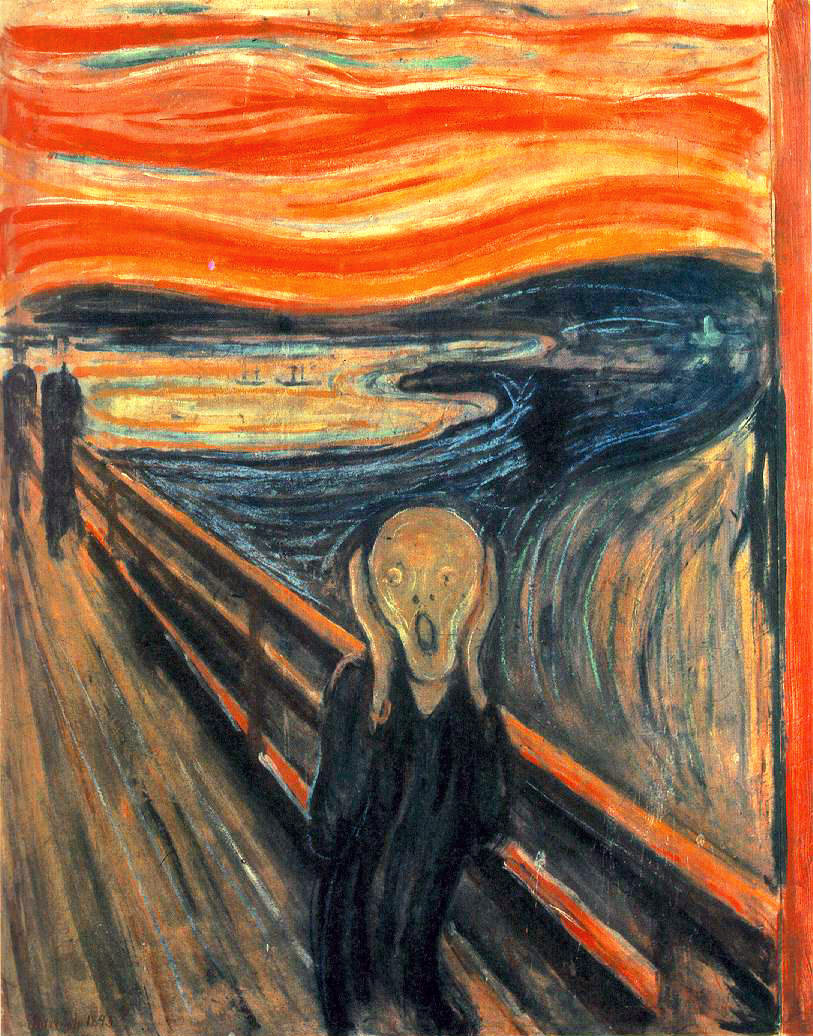
The Scream

The second poem in a series of responses to the Images in Art TY Module. This poem, by Robbie Hollis, is prompted by Edvard Munch's famous 'The Scream'.


'The Scream', by Robbie Hollis

Two men in dark clothes
Sneak up from behind
The flame red sky.
A river blends with the marbled horizon,
And creates rolling blue mountains.
The skeletal figure,
As if knowing what is to come
Is frozen, in an everlasting scream.

Saturday, January 31, 2009

The Old Guitarist

Here's the first of a series of poems written by TY pupils after a recent poetry module in on 'the image in art'. Click here for Ms Smith's introduction to the module. This poem, by Thomas Emmet, was written in response to Pablo Picasso's painting 'The Old Guitarist':-


The Old Guitarist, by Thomas Emmet

The Spanish guitar hangs
From his crumpled, haggard frame.
His deathly thin arms stretch
across it, strumming.
Each note a clawing testimony,
To his need for money, food, and life.

It wasn’t always like this.
Once, there was a home,
Once, there was a family.
It was debt that ate
These things, stole them away.

So now he sits,
Strumming the shadow
of what he was.

Saturday, January 10, 2009

TY Image Module

Today we start the second round of our modules in our Transition Year Course. There are four of these, and they give a chance for pupils to experience a topic for a week taught by a different teacher. This year, they are: Geoffrey Chaucer and the history of the English language; W.B. Yeats; a film module; and a new module taught by Ms Smith on 'Poetry and the Image', which she describes in this post:-

This Transition Year module aims to explore the link between poetry and painting. Since as far back as we can trace there has been a lively dialogue between the two art forms. Anyone who has read poetry will know that the creation of vivid images in the mind’s eye is one of the wonderful effects of this activity. Many famous painters have gone one step further and realised their interpretation of a poem on canvas. As well as going from word to image we look at the reverse. When one looks at a painting (a somewhat restricted, framed world) most are compelled to flesh out the story; what could be going on here? Who is this dark figure on the left? Why do these bright yellow sunflowers seem sinister? Writers are often drawn to translate the image back into words in their purest form; poetry.

At the end of the module students compose a poem of their own inspired by an image that fascinates them. Some forms of poetry suit particular images very well, capturing the essence of the painting. For instance, Igor Verkhovskiy has written a villanelle, an almost cyclical form of poetry based on rhyme and repetition. He was inspired by Pieter Bruegel’s 1563 painting of the spiralling tower of Babel.

(This poem can be read in today's other post here).

The images used in the course can be accessed by clicking on the links in the following list, followed by the relevant poems:-

Tuesday, January 16, 2007

Elizabeth Bishop

One of the most popular and absorbing writers on our Leaving Certificate course is the American poet Elizabeth Bishop (the selection includes 'The Fish', 'Filling Station', 'Sestina' and 'The Bight'). A fascinating recent book edited by Alice Quinn, Edgar Allan Poe & the Juke-Box, is in our Library and puts together many of her uncollected poems, drafts and fragments. It is reviewed interestingly by Gillian White in the London Review of Books here. As White writes, 'Bishop could mull over a draft for more than a decade in wait for the right line or word,' and 'as Bishop says in one of her prose drafts, "it takes great skill to make poetry seem natural".'