Showing posts with label Drama. Show all posts

Wednesday, February 04, 2015

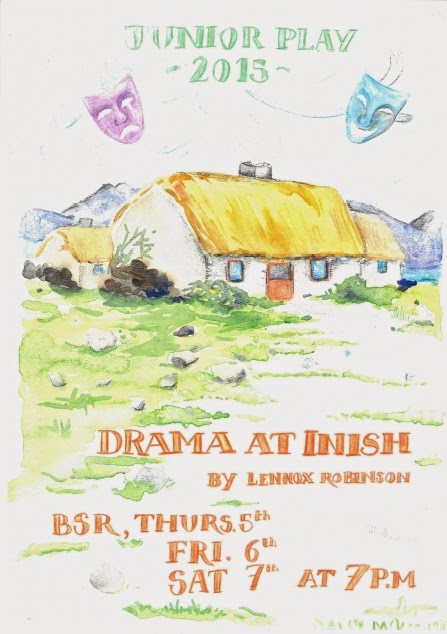
'Drama at Inish'

Poster by Daisy McKeever

The 2015 Junior Play is on this weekend, on Friday and Saturday at 7pm in the Big Schoolroom. It's Lennox Robinson's old favourite, Drama at Inish (last produced here in 2001 as the Senior Play). All parents and their guests are welcome. 

Here is the programme:

"Everyone needs some entertainment while on holidays but when the de la Mare Reparatory Company comes to Inish for the summer season no one expects the response they will engender in the locals…

Lennox Robinson is a much-loved Irish playwright who was director of the Abbey theatre for many years. Drama at Inish was first performed in 1933. It has been produced in America several times under the title Is Life Worth Living?

There are three Acts in the play, with two scenes in Act II.  The action takes place in a private sitting room of the Seaview Hotel, Inish.


ACT I: A July morning.

ACT II: Scene i & scene ii – Early evening, ten days later.

ACT III: A week later, morning.

The Players
John Twohig, proprietor of the Seaview Hotel:  Nevin McCone
Annie Twohig, his wife:  Nicole Dickerson
Lizzie, his sister:  Alexandra Murray-Donaldson
Eddie Twohig, his son:  James O’Connor
Peter Hurley, the local T.D.:  Douglas Boyd Crotty
Christine Lambert: Lena Pirlet
Hector de la Mare, an actor:  Ross Magill
Constance Constantia, his wife:  Emmanuella Ejase-Tobrise
Helena:  Grace Goulding
Michael:  Max Hillery
Jean Hegarty, a report:  Aniko Szkendy
Deirdre Mooney, a Guard: Isabelle Townshend
Slattery:  Catherine Butt

Production Credits
Make-up: Helena Gromotka, Ciana Taylor, Marie-Sophie Stumm
Poster:  Daisy McKeever
Willing Helpers:  MJ McCullough, Robbie McDonald
Costumes:  Karen Hennessey, Evan Jameson & Ronan Swift


Lights, Sound, Set, Props and Direction: Evan Jameson & Ronan Swift

Thursday, December 11, 2014

The Importance of Being Earnest


The recent Senior Play production of The Importance of Being Earnest provided great pleasure for all its audiences over three nights in the Big Schoolroom. One of the most purely pleasurable of comedies, Earnest has had regular productions over the years here; this latest one was directed with thoughtfulness and close attention to detail by Mr Tristan Clarke and Mr Ronan Swift. It is not an easy play to put on for pupils: its wordiness can be hard-going in clumsy hands. At its best, though, the dialogue fizzes from witticism to witticism, and warms the audience along the way with its easily-worn brilliance.

That brilliance was captured well by at the start of the evening by John Clarke and Harvey McCone, as Algernon Moncrieff and Jack Worthing respectively. Both were at ease on the stage; both made the audience feel at ease. Jack's part spans most of the play, and Harvey's acting was pleasingly light of foot. Perhaps the biggest reach for anyone on this cast of twenty-first century teenagers was for Darcy Maule, playing the domineering Lady Bracknell. She did very well, with a good sense of comic timing, and, impressively, she managed that line (the handbag one) without either aping her famous predecessors or pushing unnaturally for an original angle. Melissa Halpenny also did well in her first role on the Columban stage as Lady Bracknell's daughter, Gwendolen.

Best of all in this production was Phoebe Coulter as Cecily. Appearing for the first time on the Columban stage in a major role, she played the part with a beautiful lightness of touch, micro-expressions flitting over her face vividly, with a perfect sense of comic timing (nice use of the watering can). The latter part of the play was also adorned with a different kind of comedy, in Samuel Clarke's doddery Canon Chasuble, chasing after Louvisa Karlsson-Smythe's Miss Prism with nervous eagerness.

The fine cast was completed by butlers Oisin Large and Nikolaus Eggers, who drew a round of applause for the switch of sets (a pulled back curtain on a wire).

A demanding audience, few of whom knew the play beforehand, were sent happily out of the Big Schoolroom by the pleasing ending, after a couple of hours' beautifully-achieved drama.


[At the top of this post, interviews with Mr Swift and the cast put together by Dr Bannister. Here, see excellent photos of the production taken by Liz Lawrence].

Wednesday, June 18, 2014

Actiontrack 2014

On Saturday evening last the Transition Year concluded their programme with an excellent Actiontrack Showbuild. See photographs here.  One of the participants was the winner of the TY English Prize, Hollie Canning, and here is her account of the week:

Our highly anticipated five days of Actiontrack began on the morning of Tuesday 10th June. Most of us were still wrecked and drained from our active time in Achill but the Actiontrack team brought much enthusiasm, which immediately boosted the mood. 

We began the morning with a name learning exercise. I was astonished to see how quickly each of the instructors remembered everyone’s name and got to know the relatively large group. We then played the famous game "Zip Zap Boing". This game never fails to boost everybody’s energy. We then did some improvisations in small groups. These improvisations would give ideas for our show on the Saturday night. We advanced our improvisations by altering them to different genres or styles. Ours was in the style of an action movie. We showed our improvisations to the rest of the group and they commented on things they liked, found quirky, or disliked. This was a critical stage in our Showbuild because some of the ideas from these improvisations featured in our show. 

On the Tuesday afternoon we did some writing exercises. We started by having 15 seconds to write anything we could think of to do witht the colour red. We then did some word association exercises. Some people ended up with extremely random lists but this was a benefit as we constructed some song titles from these words. I came up with the title "chocolate Euphoria" which was used in the show, and coincidentally I had to sing a solo on it. We then swapped around titles and tried to write songs. That night Nathan and Nick took these songs, altered them, and chose the best for our show. I found it strange how we had the songs we would use in the show because we didn't know what the show would be about. However, the improvisation exercises we did on the first day helped us to be able to link these songs together and form a somewhat crazy, random, brilliant storyline.  

On Thursday we all got our parts along with the script. After we had a quick read-through of the script, we put them down and made a start on the set design. We all did our part in the set design, whether it was collecting branches from the deer-park, painting canvases, or constructing props. Nobody was free to mess around or doss. That evening the soloists were taken off to rehearse our solos with Nathan or Nick. Penny also taught us some of the dances and Molly directed some scenes in the play. 

On the Friday we began our intense rehearsals. We ‘’blocked’’ the script. This means that we went through it very slowly and were directed where to stand or move. This took a while but with a lot of determination and motivation from Nick, Nathan, Penny and Molly, we got through it effectively. 

We spent most of Saturday just polishing off the dances and the set. However when we did a run through of the play we realized that many people didn’t know their lines properly. With the show being at 8 o'clock that night, we were beginning to freak out. When the time of the show came, we were all more excited than anything. We had all had such a great week doing the Actiontrack Showbuild that we were in good spirits. There was still that possibility that people would forget their lines or mess up, but we were ready to improvise if needs be.

The performance itself went very well. The was a great vibe in the BSR and I even saw a few of the teachers tapping their feet to our groovy tunes! Overall I think that it was a great experience to use our own ideas and make a show and I would really urge people to take part when it's their turn. It’s a brilliant few days and I can honestly say I learnt a lot, and my dancing moves have definitely improved!

Sunday, February 09, 2014

Candide: the 2014 Junior Play

Over the last three nights, the Big Schoolroom was taken over by an excellent production of an adaptation of Voltaire's Candide. One of the visitors was our former Head of English, John Fanagan, and these are his thoughts:-


Ten years ago, in 2004, a major refurbishment of the Big Schoolroom took place, which gave a wonderful new lease of life to the nineteenth century building's use as a performance venue. The audience for this year's Junior Play, Candide, enjoyed a very creative and visually arresting use of the space. In the traditional stage area were banked rows of seating. Likewise on both sides of the Big Schoolroom. At the Cadogan end, and right down the centre, were the main acting areas. Ronan Swift and his fellow directors produced a fast-moving and highly enjoyable version of Voltaire's novel.


The central character, Candide, is hardly ever off the stage. Casting James O'Connor was a bit of a gamble: he is very young (I Form) and his voice is not as strong or developed as some others in the cast. However, as the performance unfolded, I became increasingly convinced. His (relative) youth emphasised the essential naivety and optimism of his character. He has a sympathetic stage presence and was very assured in a most challenging role. In the plot he was often at sea, but never in his acting.


There were more than twenty other young actors in the cast, the majority of them playing more than one role. Their versatility and easy transition from one character (and/or gender) to another were very impressive. The exotic costumes added to the spectacle, particularly on Mantuk Suen as the Sofi. Freddie de Montfort's roles as Dutch Citizen/Monkey/Prime Minister will give some idea of how they had to move from one extreme to another. There were some very strong performances among the single role characters. Aisling McBurney was a pert and coquettish Cunnigonde. After a quiet start, the role of the servant Cacambo was played with mournful authority by Ralph Sweetman-Sutton. Ross Magill had everyone in stitches as the Old Woman (imagine an eighteenth century Mrs Doyle from Fr  Ted). Michael Kennedy had the the scene at the start as Narrator mad a brief (but highly effective) cameo appearance later as Don Issachar.

The cast were roughly fifty-fifty boys-girls and some of the girls gave  especially confident performances: Darcy Maule as the Queen of Bulgaria and Elizaveta Kozhevnikova as Sergeant/Dervish come to mind. I was sitting  beside an Old Columban from the 1980s, Hugo Smythe, who was obviously enjoying his  daughter Louvisa (Soldier/King of Eldorado/Whip Master) as much as she was enjoying herself on stage. That enjoyment pervaded the production. They were all having the best time; I thought Mark Crampton (Baron)  might levitate, he was having such a ball. All of the cast will long remember participitating in such a lively and imaginative production.

Music and sound effects helped move the production along. I particularly enjoyed hearing Tristan Clarke's Sine Nomine choir making their contributions. When you look at all the pupils and staff involved, you realise what effort, on so many levels, went into this Candide. I would applaud the producers' ambition and the great pleasure they gave to cast and audience alike.

John Fanagan.

Sunday, November 17, 2013

Review of 'An Inspector Calls'

On Thursday, Friday and Saturday we saw the excellent Senior Play production of J.B. Priestley's 'An Inspector Calls'. Here Sofia McConnell from Fifth Form gives her account of the play:


The play starts in Brumley, North England, in the home of a rich industrialist. It is a spring evening in 1912 and the Birling family have just risen from a comfortable family meal, celebrating the engagement of their daughter, Sheila, to Mr. Gerald Croft. The lights shine onto a small set. Four straight-back chairs surround a coffee table in the foreground; to the left there is a large armchair under a lamp. At the back of the stage there is another table, on it a collection of old, leather-bound books and an assortment of drinks. Enter stage right, Sheila (Siobhan Brady) and her young, wild brother, Eric (Sam Clarke), talking, laughing and drinking. They are soon followed by the rest of the party; Arthur and Sybil Birling (Mark McAuley and Gabriella Masding) and Gerald Croft (Aidan Chisholm). Once they are all seated and happily talking, the maid, Edna, (Lydia Johnson) brings in a round of port to finish off a successful evening. So all is well in the Birling household.

A short while later, the bell rings. Edna announces the arrival of an Inspector Goole (Mark Russell). He is here to investigate a suicide case. The suicide of a young, pretty, working class girl, Eva Smith, who killed herself by drinking strong disinfectant. As the plot progresses and thickens the audience is captured up in twist after turn of the inspector’s vigorous questioning. We learn of her previous employment and dismissal at Birling’s factory, of Sheila’s upset at a clothes shop where Eva had found work, which results in Eva being fired again, of Gerald’s “helping hand” once Eva (after changing her name to Daisy Renton), has been reduced to a “different kind of life”. Next to be revealed is Mrs Birling’s prejudiced refusal to give help to Eva from the charity committee of which she was president, simply because the girl, in her desperation, lied about her name and situation. Finally the horrifying truth of Eric’s drunken nights about the town comes out, how he made the same girl pregnant and stole money from his father to support her. The audience watches, helplessly, as Inspector Goole rips apart any walls, any confidence or comfort that this family has established. They fall into disarray, quarrelling, shouting, crying and lapsing into utter despair.

After the inspector has left, Gerald suddenly has an idea that they have been fooled. All expectations are raised suddenly as the inspector turns out to be a fraud. They see a hole through his questioning. What if they’re not all talking about the same girl? What if the “inspector” was pulling their leg and making them believe a collection of girls was actually only one girl. When they call the infirmary and ask about the arrival of a suicide victim that afternoon they are relieved to hear that there was none. All but Sheila and Eric, who are still appalled at all the horrifying truths that have come out, laugh and smile. It seems that, although all is not as it had seemed an hour ago, and although Sheila has broken off (for now) her engagement to Gerald and it seems as if life can go on in the Birling house without public scandal. Suddenly the phone rings. Silence falls on everyone in the room. You could hear a pin drop in the audience. Arthur walks slowly towards the telephone and raises it to his ear. A girl has arrived at the infirmary. A suicide victim, she swallowed a strong disinfectant. A police officer is on his way to ask some questions. All hope is shattered.

The cast were all brilliant and never lost character for a moment. I believe Mark Russell (the inspector) deserves huge praise for his outstanding performance, but huge effort was put in from every one of them and it all paid off. Mr McCarthy and Mr Swift produced an amazing play and so a big thank you to both of them. Overall I think the play was a great success. The whole audience was enraptured from start to end and, when asking people what they thought of the play as they were leaving, one parent told me it was the “greatest, most thrilling performance I have seen in St Columba’s yet.”

Thursday, November 14, 2013

An Inspector Calls

Tonight sees the preview of this year's Senior Play, J.B. Priestley's An Inspector Calls, directed by Mr Peter McCarthy. Rehearsals have been under way since near the start of term.

In this classic drama of mystery and shared responsibilities a small cast is asked to give intense performances over three acts. The play, to be performed on three sides, is set in the early part of the 20th century on a night of self-satisfied celebration for one wealthy family. But not all is rosy in the Birling household...

The first performance proper is in the BSR on Friday 15th November, at 7pm, and the second performance the following evening - same time, same place. All parents and their guests are most welcome.


(Poster by Molly Dunne)

Wednesday, June 12, 2013

Actiontrack Diary 2013: Days One & Two

Ally Boyd Crotty and Sofia McConnell will be reporting each day this week on their experience of the Actiontrack Showbuild in the BSR.

Tuesday 11th June: This was the first day of this year's Transition Year Actiontrack Workshop. We started the day with various warm up games such as zip zap boing, a game we had played before with the Actiontrack crew in second year, as well as various name and shape games. We then put our acting skills to a test and used these shapes to create mini-plays of our own. Later on in the afternoon we began playing word games, which to us seemed pointless, but little did we know they would expand into bigger ideas for the play itself. We had to place these words together to create song titles, and were then given the job of putting lyrics to these titles. Everybody got stuck in and enjoyed themselves.
 
Wednesday 12th June:  On the second day, after our warm-up games, which were mostly vocal, we all gathered around the piano to sing our newly made song choruses, with the crew playing instruments along to the lyrics they had improved from the day before. Each song was catchy and had a western theme, which we found out would be the basis for our play. We were then given songs and told to put stories to them, and acted out the scenes. Ideas from these were jotted down and could contribute to the final production. Even though it was only a small start, we could see the play beginning to be formed.

Wednesday, February 06, 2013

Twelve Angry Jurors

Last weekend saw the two performances of the annual Junior Play, this time Twelve Angry Jurors (adapted from the original 'Men' and best known for the film version featuring Henry Fonda) by Reginald Rose. Here, Ally Boyd Crotty from Transition Year reviews the production:-


On Friday 1st and Saturday 2nd February a cast of eleven Transition Year pupils and three third formers performed a thoroughly rehearsed play called Twelve Angry Jurors. The play was presented in three acts, and was excellently directed and produced by Mr. Swift.
     
Before the play had even begun the unusual and intimate layout caught everyone's attention - in the middle of the BSR (instead of on a raised stage) was a table around which the audience sat in tiers. This meant that everyone felt more involved, and this layout also resulted in everyone being able to see properly.

The play was about a nineteen-year-old boy on trial for murder. It followed the decisions of the jury involved in the case. When the jury first began their discussions at the beginning of the play, they first decided to see where they stood by taking a vote. The vote stood at eleven to one - eleven voting that the boy was guilty. Only one voted not guilty, and this was jury number 8, played by Christian McKeever.
       
For the remainder of the play we tracked the jury proceedings, and watched as the eleven jury members gradually began to be convinced by number 8 that the boy was not guilty, until finally Alex Barnes-Auld cracked and the boy was acquitted. The tension was cranked up skilfully, as the actors revealed the motives and attitudes behind each juror’s decision-making. Eireann Tinkhof, Alex Barnes-Auld, Iyobosa Bello-Asemota, Jamie Maher, Eliza Hancock, Nadia Al Lahiq, Oisin Large, Arthur Moffitt, Alina Stiehler and Muqtadir Shah performed the parts of the other jury members, while the foreperson of the jury was Celine Klee. Eleanor Moffitt and Janet Boyd played the parts the judge and court clerk.

The standard of acting by all members of the cast in my opinion was extremely high, everyone stayed in character and there were no errors to be seen. This production got an extremely good reaction by everyone who was fortunate to have been able to see it, and I would say it was very successful.

Tuesday, November 27, 2012

'Fiddler on the Roof' review

Alex Owens of V form here reviews the recent College musical Fiddler on the Roof:

On the 17th November the SCC Drama Department presented their final performance of this year’s college musical: Fiddler on the Roof. After months of hard work, starting back at the end of June when final casting was drawn up, and scripts  given out for learning over the summer, the production was completed and  staged in the BSR over three nights. 

The play itself is based on a novel by Joseph Stein, set in a small village known as Anatevka in 1905 before the Russian Revolution.  The story revolves around the main character Tevye played by the very talented Zachary Stephenson. Tevye is a father of five daughters and the story shows his attempts to maintain Jewish religious traditions and support his family.
    

We see how Tevye copes with his three eldest daughters taking their own choice of husband, slipping further away from him and his faith. He also has to listen and take advice from his sharp-tongued wife Golde, played by the accomplished Siobhan Brady.  

The evening opened with the Fiddler’s signature song ‘Tradition’, which is the main idea which the story is centred around, sung by the entire cast. Also accompanying the cast was pianist Margaret O’Sullivan Farrell and violinist Mary Fitzgerald, brought in especially for the performances by musical director Geraldine Malone Brady. However much more was to come throughout the night with many more numbers such as ‘Matchmaker’ sung beautifully by the three eldest daughters Sally Beeby, Molly Buckingham and Pia Gromotka. Following that, we heard a fine performance of ‘If I were a Rich Man’, sung powerfully by none other than the star of the show, Zach Stephenson and other solo parts with excellent singing by Arthur Moffitt, Sinead Alari, Siobhan Brady, Mark Russell and Mark McAuley. For the musical finale we had the mournful patriotic number ‘Anatevka’ sung by the entire cast.  

The use of light to depict the mood proved to be very effective against the minimalistic background. But the costumes without a doubt took centre stage in being a key role and completing the look of the whole performance, all of which were hand-picked carefully and created by Costume Director Karen Hennessey. In terms of the acting quality of the play, none of this would have been possible without the direction and encouragement of the head of Drama Mr Swift, and special thanks must go to Mrs Malone Brady for her superb musical contribution and coaching of such a large cast.

Overall it is quite clear that this was another enormously successful production from the Drama Department, displaying top-quality performances containing pupils from different year groups throughout the school and they should be commended for their hard work and devotion to a magnificent end result.


Click here  for a photo slideshow of the production.

Monday, November 19, 2012

'Fiddler on the Roof' photographs


Above, a slideshow of photographs of last week's hugely successful production of Fiddler on the Roof, taken by Mr Peter Watts.

Wednesday, November 14, 2012

Macbeth 10: Act 3 scene 1 - 'To be thus is nothing'

This is the tenth in a series of analyses of key moments in Macbeth using the iPad app ShowMe.

This is the beginning of Macbeth's soliloquy in III i, in which he expresses his fear of Banquo and of 'nothingness', and continues his precipitous moral decline.

Friday, June 22, 2012

Actiontrack 2012

Below, a slideshow of photographs from last Saturday's Actiontrack show for 2012, Weaver Story To Tell, inspired by Ovid's Metamorphoses...

Friday, June 15, 2012

Actiontrack 2012, Day 4

Alex Owens reports on the penultimate day of this year's Actiontrack project for Transition Year:

Day 4. This morning we started off with another full music rehearsal of all the songs for Saturday night along with bringing in the soloists that were chosen for the songs that were worked on yesterday. Following this we took off from where we finished yesterday evening, quickly trying to make our way to the last scenes of the play before break. Unfortunately there are a few hiccups and slips along the way, causing a delay. Nevertheless steadily throughout the day we all kept on working on any costumes props and set-pieces needing work (in between our scenes in our play). Along with this the rest of the choreography for  all the songs was created and put into practice by us all. However as the day came to an end our brains grew tired and we slowly began to lean against the wall. (Notice my new rhyming skills...) Tomorrow night all will be REVEALED!!

Thursday, June 14, 2012

Actiontrack 2012, Day 3

 Alex Owens reports, now over half-way through the Actiontrack Showbuild:

Day 3. First thing this morning we had a full music rehearsal with the song-writer and musician in the Actiontrack crew, Rich, and finally our script was given out (created by Nick, Molly and Rich incorporating all our ideas). After break we were given our final parts for Saturdays performance! Quickly enough we began to go through every scene getting a feel for the whole thing. Along with this we all began making decisions on costumes, props and solo parts for the songs. After lunch more of the stage set design was slowly but gradually worked on, along with choreographing the first of our big hit songs.

Friday, May 18, 2012

2012 Drama Prizes

Many congratulations to the winners of the annual College drama prizes:-
  • Senior Drama Prize: Robin Fitzpatrick, for his work in the Shakespeare Society production of The Comedy of Errors in November (playing Antipholus of Ephesus).
  • Fry Prize for Stagecraft: Opeline Kellett, for her contributions to College drama.
  • Junior Drama Prize: Lydia Johnson and Mark McAuley, for their work in the Junior Play, The Field, in March.

Wednesday, March 28, 2012

II Form Actiontrack

Last week, II formers took part in the annual Actiontrack drama workshops over three days, with Nick and Molly. Afterwards, they wrote down their reflections on the experience, and here is a selection of comments:-

  • I thoroughly enjoyed Actiontrack: it really helped me think about how to act and how to go about doing the small things in acting which make a huge difference - for instance, the length of stride in your character's walk. 
  • At first I didn't know what to expect, but Molly and Nick were encouraging and enthusiastic. It was extraordinary how unique and personal are our walks are ; they differentiate characters.
  • We followed each others' hands and body parts: it taught you control, especially when you're leading someone.
  • It was a very fun and enjoyable experience and I can't wait to do it again in fourth form.
  • Nick and Molly were the first people I have met that express themselves in such a theatrical way.
  • I have never really enjoyed acting but Actiontrack made it fun. I had never been taken in so much depth into acting and really enjoyed mimicking.
  • I think the coolest part was when we got to add more emotion to characters.
  • I learnt that to create a character and story you only have to do the simplest of things.
  • The first thing we worked on was how to become someone else on the stage. They used a very simple exercise: look at each other's walk and try to do the same. That made me realize how different people are, even in their most common movements.
  • I think it was a big advantage to be a small group: we got personal advice, which was especially beneficial.
  • One of the most important thiings I learnt was when you are told to do something or given a direction, don't look around to see how everyone else takes the order - just go with your instincts and what you think is right. 
  • I think that doing Actiontrack has been the most fun I have had in a long time.
  • It was really interesting, the way we had to notice and be careful with details.
  • Working with spaces: we had to be really careful just opening a door! Indeed, a lot of us used to ring the locker with them having opened it, or simply walked into the wall. We had to imagine everything, which was really tricky. We worked on entering a swimming pool, but most of us couldn't even reach the ticket kiosk without making at least four mistakes!
  • Watching people's walks: this was very funny and interesting. It made me realise  that I lift my shoulders up when I walk. I never knew I did that!
  • I definitely wish we could have something like this once or twice a week. It really gives permission to you to have fun and be free while doing something educational. If this were to happen I think it would be one of the school's greatest ideas yet. Thank you for a wonderful and educational experience.

Friday, March 02, 2012

'The Field'

The Junior Play, John B. Keane's The Field, is on tonight and tomorrow night in the BSR. Below, Garry Bannister's video introduction to the production.

Thursday, March 01, 2012

'The Comedy of Errors' at NTLive

Tonight, the cast and crew of our November 2011 Shakespeare Society production of The Comedy of Errors are looking forward to see their equivalents in the National Theatre in London perform the play, via the live telecast into the local cinema in Dundrum.  Below, the trailer.

Wednesday, January 11, 2012

Junior Play 2012

Auditions for the 2012 Junior Play, John B. Keane's The Field, are being held in the BSR at 1.15pm today. Have a go!

Wednesday, December 07, 2011

'The Comedy of Errors' review

Konstantin Behr & Robin Fitzpatrick
Shannen Keogan reviews the recent Shakespeare Society production of The Comedy of Errors:-

On a dark wet evening on Saturday 19th of November, in Saint Columba’s College, there really was no better place to be than sitting in the buzzing Big Schoolroom listening to the classic tunes of the 70’s and dancing in our seats whilst we all anticipated this year’s Senior Play, The Comedy of Errors by William Shakespeare.

If we didn’t think the blaring 70s beats were good enough, suddenly we were graced with the presence of the one and only keyboard extraordinaire Lingfan Gao, looking as some would say “Elton John-esque” in what really was the sparkliest jacket of gold and silver sequins that I have ever seen. When the lights dimmed and the sweet and sombre sound of Lingfan’s keyboard began to play the mellifluous tones of Catie McGonagle's voiceover introduced the story.
                                                                                                                                                                                  
The story itself is a complex one and I thought that Patrick Tice who played Egeon did an excellent job of trying to explain the utterly chaotic plot in the first scene of the play. He informed the ruler of Ephesus (Kezia Wright) of how he and his wife had a pair of twin babies both called Antipholus who were separated on a sea journey in a storm. In the storm Egeon is separated from his wife and one of his sons. If that wasn’t confusing enough, on the exact same day another set of twins had been born to a local poor woman who Egeon bought to grow up as servants of his twins. These servant twins were both called Dromio. So the story begins with Antipholus of Syracuse (Zach Stephenson) and his loyal servant Dromio (William Maire) setting off to find their long-lost brother.

Now, a Shakespearean comedy really just wouldn’t be a comedy if it didn’t have a crazy over-dramatic and completely confused woman in it and this was Adriana who was played fantastically by Opeline Kellett. She, along with her sister Luciana (Bella Purcell) are baffled by the peculiar actions of her husband Antipholous (Robin Fitzpatrick) and their slave Dromio (Hamish Law). But the most confused characters of all were definitely the Antipholus twins (Robin and Zach) and the Dromio twins (Hamish and William). These four have to be commended on what really were flawless performances on their parts.

Not only was the acting of an incredibly high standard this year but so were the stage production and costumes. With the use of some new modern technology, a beautiful tower clock, very colourful garments (organised by Ms. Hennessey) and great music, the comedy sense of the play had without doubt been fulfilled in a most professional manner. And with some hilarious acting from the local police officer (Konstantin Behr) the local courtesan (Rachel Rogers) and many more, I never ceased to stop giggling throughout the performance. All of this of course was due to the 19 performers who put months of hard work and effort into preparing their roles under the direction and guidance of Mr. Girdham and Mr. Swift, who have yet again left us with another exceptional drama production, and for this they must all be congratulated.