Showing posts with label School Events. Show all posts

Sunday, May 24, 2026

Second Form Public Speaking Competition 2026


This weekend saw the annual Second Form Public Speaking Competition take place in the Big Schoolroom. This provides an opportunity for Second Formers who have recently completed their oral Classroom Based Assessments to present them in front of an audience beyond their class sets.

The topics this year were extremely varied, as the compère Mr Girdham said, often jumping from one subject to an utterly different one with a very different tone. First up was Max Morrissey, who talked about wages in professional sport, and he was followed by Fiona Zhong (Could aliens be real?), Sam Butler and Oscar Duggan Geary as a pair (tennis), Ella Girdham (a cold case in crime), Yonette Nel (Irish weather), Alex O’Herlihy (living with cystic fibrosis), Alisha Corrigan (Irish mythology), Henri Rose (‘waking up tiny’), Lucy Branagan (why pigeons are secret government spies) and finally Esmonde Durdin Robertson (why young people are leaving rural Ireland).


Ms Kent-Sutton and Mr G. Clarke were the judges, and they emphasised how much they learned, how often they were entertained, how well all the speakers did on conquering their nerves, and the way all engage the audience with a clearly sequences structure of information. They announced that Fiona had come third, Yonette second, and the winner was Lucy Branagan with her quirky conspiracy-type piece on alien pigeons.


Many thanks to the pupils’ English teachers, Mr Canning, Mr Kirwan and Ms Tyerman, who prepared these pupils and many more over the last three weeks.

Tuesday, May 27, 2025

Junior Public Speaking Competition 2025


The Junior Public Speaking Competition organised by the English Department at the end of May each year is part of a continuum of public speaking opportunities which our pupils have, and which help them build confidence and fluency. This starts in the First Form competition in front of their peers in English class, and includes the Transition Year House Speeches and House debating. ‘Oracy’ is the technical educational term: before long, reforms in the Leaving Certificate English course mean that candidates will need to talk to external examiners about literary texts.

Judging by this year’s competition, when the pupils reach that year, they will have no problems. Building on their oral Classroom Based Assessments, eight Second Formers spoke in the Big Schoolroom on the evening of Saturday 24th May on a great variety of topics, and did so very well (and several without any notes). Mr Girdham was the judge; he asked each speaker a question or two after their piece.

Zora O’Rourke was first, making a provocative argument that we should reinstate corporal punishment. As she admitted, she doesn’t really believe this, but she made the audience sit up at the start and think. Emily Su also provoked thinking, as she imagined what it would be like if we never had to speak. She pointed out that we spend about a third of our lives asleep, and this might seem a waste of time. But, of course, the benefits of sleep are considerable, and life without it would be impossible. Next was Marianna O’Shaughnessy, who gave a vivid and detailed account of her great-aunt Helena Pyz, who despite disability has achieved a huge amount in her work in India – certainly, a life well lived. ‘Dissociative Identity Disorder’ is also something which could disable a life, and Mirella Pelly explained clearly this complicated and distressing condition.

The second half of speakers was headed by Maureen Deng, whose ‘The benefits of space travel’ contained several quirky scientific facts. She was followed by Bosco Quesada Torrejon on ‘The Power of Small Habits’, those little things which make life that little bit easier, but which also can have negative effects. Then Laurence Sun gave a comprehensive and mostly positive account of the effects of Artificial Intelligence, including possible job displacement. Finally, Georgia Dobbs addressed the matter of teenage girls and sport; her clearly-delivered speech was well-structured and used her own experience effectively.

The winner was Laurence Sun for his polished and knowledgeable address; all other speakers impressed in what was a pleasing evening.

Monday, May 30, 2022

Voices of Poetry 2022

Sunday evening saw the special event that is Voices of Poetry return to the Big Schoolroom in its long-lasting and infallible format: a pupil or teacher reading a short poem after a brief explanation in a darkened room, picked out by a single spotlight. Some of these were in languages other than English: it is amazing how powerful such readings can be, even if you don’t understand the lines. The evening was organised by Mr Swift, and the presenter was Mr Girdham.

Marianne Lee from First Form opened proceedings, with her own evocative poem ‘The Witching Hour’, followed by Mr Jameson from the English Department with a translation of a poem by the Swedish Nobel Laureate Tomas Tranströmer, 'The Tree and the Sky'.

The other languages kicked in: poems in Italian (Alexia Fantacci), German (Toni Ladanyi), Cecilia Corti (Arabic), Irish (Dairbhre Murray) and Chinese (Harry Wang). The aural contrasts were fascinating.

Mr Girdham then read out ‘Resistance’, recently written by the British Poet Laureate Simon Armitage in solidarity with all those under fire and bombardment in Ukraine, which led on naturally to Pavlo Shvalov reading a piece in Ukrainian celebrating his country’s independence.

Another step change was to Leonid Mylvaganam, who read out his own flowing work, close to performance poetry. Three European languages came next: Dutch (Josefien Hutchinson), French (Eole Mignot) and Spanish (Mateo Aliaga). Again, it was remarkable to hear the differences even though you can drive from one country to the next.

This year’s Junior Poetry Prize was won by Delia Brady, and her poem 'The Moon' was read by Anna Rose McManus.  She was followed by the Warden, who said that from a young age at prep school he had to learn poems off by heart, and he recited G.K. Chesterton’s ‘The Donkey’.

Then, Slavic languages were represented by Polish (Dr Pyz) and Czech (Phoebe Landseer).  

The next two poems brought us close to the end, with two people who are soon to leave the College: Ms Heidi Kavanagh (Yeats’s ‘When You are Old and Grey’) and the Senior Prefect, Evie Pringle, with Stevie Smith’s 'In My Dreams'.

And finally, Mr Canning announced the winner of this year’s Peter Dix Memorial Prize for Poetry (pictured), Isabella Treacy, and read out a poem from her winning portfolio, 'The Knots'.

To conclude, Mr Girdham recommended Pádraig Ó Tuama’s podcast Poetry Unbound: a short podcast twice a week on a single poem, with
Ó Tuama’s reflections. It does what poetry should do for readers: provide a space for attention away from the busy noise of the world. And that is just what Voices of Poetry does too.

Tuesday, October 10, 2017

House Speech Competition 2017


Eliza Somerville from Fourth Form reviews the recent TY House Speech evening:

An evening full of captivating speeches began with a talk about concussion from Thady McKeever. He spoke about the dangers of contact sports, and the effects of repeated concussion on the brain. He ended his speech with a thought-provoking anecdote about an American football player, who ultimately died as a result of his eighteen-year career in professional sports.

I thought that this speech was very engaging. It began with a strong metaphor of your worst enemy hitting you with a bowling ball, and it was shocking to learn that this is equivalent to the force of a boxer’s fist. I also thought that the story about Mike Webster at the end of the speech was very powerful, as it showed the real-life effects of contact sports on the brain and body.

Next, Frances Wilkinson told us about the Butterfly Effect. She explained how small events can have huge, unforeseen consequences. For example, a butterfly flapping its wings could eventually create a tornado. She used an example of a man who spared the life of a soldier in World War I. This soldier turned out to be Adolf Hitler, who was responsible for millions of deaths in World War II.

I found this speech very interesting, as I was curious about how large an effect a small change could truly have. From the examples Frances used, I realised that even the smallest of actions can change the course of history.

Alexis Haarmann then told us about the controversy surrounding the death penalty. He explained that five per cent of people who are sentenced to death turn out to be innocent, and pointed out that waiting for the death penalty to be carried out is mental torture even for rightfully convicted criminals. I thought that this speech gave me a good background to the death penalty, and it made me more convinced that it should be abolished everywhere.
Ben Upton then outlined each side of the argument on whether marijuana should be legal or not. He explored both the recreational and the medicinal side of marijuana, explaining how the legalisation of marijuana would benefit the economy, and how people who experience seizures can benefit greatly from the use of medicinal marijuana. He eventually came to the conclusion that marijuana should not be legalised, as it just causes people to drift further and further away from reality. This speech was well-researched and it was an interesting view on the controversial topic of marijuana’s legalisation.

This was followed by an impressive speech from Tania Stokes on climate change. She first acknowledged that thinking of global issues can be daunting, and then emphasised that even one person changing their behaviour can have an effect on global issues. She then told us some simple tips on how we can reduce our own carbon emissions and waste. Tania ended her speech by telling us to imagine the most beautiful place we’d ever been to, destroyed forever because of climate change.

Tania’s speech stood out to me as she clearly knew her topic very well, and she was truly passionate about environmental issues. I thought that her ending, where she told people to visualise an amazing place, gone forever, was very strong, as it emphasised the shocking influence climate change could have on our world over the next hundred years.

Next, Andrew Kim gave a speech about transport. He pointed out that, four hundred years ago, people had to walk everywhere, or if they were lucky they had a horse. He described the efficiency of the transport system in South Korea, where they have a single card for all modes of transport. Andrew then went on to talk about the various improvements in transport in recent years, such as self-driving cars and the Hyperloop.

Andrew presented what could have been a dull topic in an engaging way, showing how our lives would be drastically altered if modern transport did not exist. I also found the modern advancements in transport fascinating.

Sam Lawrence then gave an absorbing speech about conservation. He informed us about the issues caused by our over-consumption of products such as palm oil. Deforestation of palm trees is occurring at an alarming rate, as fifty per cent of all products in an average supermarket contain palm oil. Sam covered many important issues in his speech, and showed how vital it is to conserve our planet’s resources.

Afterwards, Sophia Cabo spoke about divorce. In her speech, she drew from personal experience to paint a stirring picture of what it is like to go through the divorce of your parents at a young age. Sophia said that there are three stages to divorce: sadness, anger and happiness, and revealed that she was finally in the happy stage.

In her speech, Sophia showed a side of divorce that many people do not get to see. I thought that she described her journey through a difficult time very effectively.

Killian Morrell then talked about the Beatles. He said that his dad was a fan of the band, so Killian had grown up listening to their music. He added that now, when he listens to their music, he instantly gets nostalgic because it reminds him of his childhood in Dubai. Killian’s speech was unusual, and it gave an interesting picture of the different musical influences in his life.

Finally, Sophia Cole talked about women in sport. She said that recently, people have begun to see that women should not work solely in the home, as they have a lot more to offer. However, she explained that there is still huge inequality between men and women’s sport. For example, men get paid a lot more money for playing the same sport as women, and often get to play in drastically better venues than women.

Sophia raised some interesting points, and her speech was both clear and coherent. It was shameful to hear some of the inequality women still experience in the world of sport today.
At the end of the evening, I thought that the joint winners, Thady McKeever and Tania Stokes, were well-deserving of the prize as their speeches were both compelling and thought-provoking, and they each approached their topics with striking originality.

Friday, June 02, 2017

Transition Year English Evening, 2017


On Tuesday last we held the 24th annual TY English Evening in the Big Schoolroom. The guest speaker this time was Professor Colin Graham, Head of the English Department at Maynooth University.

Eight pieces from the recent Work Portfolio were read out by their writers: Ross Magill (his first Primary school); David White (the nature of 'failure'); Lucy Maher ('A Picky Eater'); Toby Green (Blanche Dubois's diary); Anna Bofferding (Donald Trump and World War III); Andre Stokes (a poem called 'Young Musician'); Casper v d Schuelenberg ('The Oldest Person I Know' - the Holocaust survivor Marko Feingold); William Zitzmann ('Thought Bubbles', assisted by Grace Goulding).

Professor Graham commented with great attentiveness and sympathy on these pieces, saying how much he was impressed by the writing on display. Each piece had made him think of another writer. He stressed the vital importance of a multiplicity of voices in today's world, and how important it was that young people lead this way (in many ways his own generation has failed them).  He quoted from Sam Riviere's controversial book of poems Kim Kardashian's Wedding.

Finally, the Premier Awards were announced after this year's course:  
Ross Magill, Helen Crampton, Harry Oke-Osanintolu, Catherine Butt, Caspar von der Schülenburg, Julius Reblin, JiWoo Park, William Zitzmann, Toby Green, Isabelle Townshend, Sophia von Wedel, Nicole Birlain Zeigler.

Tuesday, October 18, 2016

Transition Year House Speeches 2016


Pol Casas Abella from Fourth Form reviews the annual TY House Speech competition:

On Sunday 2nd October, all the college had the privilege of hearing 10 magnificent speeches from the Transition Year  forth formers. The judges were Mr. McCarthy, Mr. Watts, and Henry Carroll, who was awarded third place in last year's event. Above all, I want to say that (before commenting on their respective performances) every single participant deserves respect. We all know that what they did was not an easy task. However, this pressure didnt seem to the participants; almost every one of them had great enunciation, adopted an effective variety of tone of voice and looked very confident on stage.

Caspar Schulenberg opened up the night's entertainment with his speech based on satire. He gave his opinion on what he enjoyed about this topic, highlighted some examples to make us understand what he said, and emphasised the things that he would change to make satire even better. I thought that the speech was worthy of being placed  as one of the top three, due to both the confidence that he showed and the content that he offered. A lot of people would like to have his public speaking gifts.

Then it was Isabelle Townshend's moment to shine. Her speech was very interesting due to the fact that 9/11 is a subject that Im passionate about. Moreover, she talked about it in a singular manner, defending a conspiracy theory that most people are sceptical about. I think that she was very bold in choosing to speak about her controversial topic, but at the same time she had a lot of facts supporting it.

After Isabelle came Ross Magill. I must mention the great tone of voice that Ross had. He looked very confident and comfortable while speaking. At the same time, he managed to be very funny (if not hilarious) and made the audience have a great time. I absolutely agreed with the second place that was awarded to this performance.

Catherine Butt was next. This student is in my English set and therefore I already knew my thoughts on her speech before she started talking. Anyway, I loved the way that she described and referred to her mother. It was the perfect mixture between tenderness and realism.

When Catherine finished, Harry Oke-Osanyintolu started speaking. From my point of view, he was the highlight of the night. Why? Because his speech had all the requirements needed for winning success: passion, well-memorised, an engaging subject and even acting while delivering the speech. This performance definitely had all these points. Honestly, I was surprised when I found out that he hadnt won. (This is of course without taking merit from the actual winner).

Joel Taylor kept all the audience involved in the event thanks to his polemical speech based on anti-feminism. As he said, its better to defend what we think and the truth, rather than being politically correct. That is why I admired his performance, although he shouldnt have used any notes, and nor did he need them.

Now its time to talk about the winner: Anna Laurenceau. Some people, like me or even herself, were surprised at the choice. However, later on I had the chance to think about it and I could understand it. Talking about soccer with the passion that she did being a female, is an unusual occurrence. Even though she forgot some tiny parts of what she had to say during the performance, she was able to recover from these mistakes and this culminated in a great speech.

Ted Johnson decided to pick Space and the human achievements made thereas his topic. I know (almost for sure) that if he had memorised his speech properly, now we would be talking about one of the most remarkable speeches of the event. Unluckily, this was not the case and, although  significant and interesting research had been done his problems on stage delivering it from memory faltered too often and this made the speech sound less prepared worse than it actually was.

Then the next participant started his speech off with one word. Cancer. This is how Greg Kryukov kicked off his performance, and how he got all our attention; by saying the name of what he was going to talk about. It sounded simple, but I thought that it was a really smart move from him. In addition, he talked about all the must-mention facts surrounding the disease.

To finish off the event, Josephine Krieger spoke about the other side of JoelTaylors topic. Feminism. She defended her reasons very well, and made us all understand some of the wider issues of sexism nowadays.

In conclusion Iona won the overall prize. Anna Laurenceau won as an individual with Ross Magill and Harry Oke-Osanyintolu in joint second place. I and everyone agreed that all the speakers made an incredible effort that resulted in, as Mr. McCarthy said, one of the best House Speeches in a long time.

Saturday, June 04, 2016

Voices of Poetry 2016

Last Sunday evening saw again the lovely annual occasion which is Voices of Poetry, expertly co-ordinated for the eighth year by Mr Swift. As we have often mentioned, it is an infallible formula - lovely short poems in different languages read on the final 'full' weekend of the year. And so often it seems blissfully sunny outside, contrasting with the dark hush of the Big Schoolroom, which is broken by a single spotlight. The photograph was taken 15 minutes before the event began, on the way to the BSR.

Nyla Jamieson's 'Dancing', written for the Senior Poetry, was first up, followed by another entry, Oisin Large's 'The Time has Come'. Second Prefect Bunmi Oyateru then read a poem by Amiri Baraka. The foreign language poems started with one in Russian (Elizaveta Kozhevnikova). Douglas Boyd Crotty followed with Irish and Jack Thurk with 'American' ('On the Death of a Next-Door Neighbor').

French was represented by Ciara Gumsheimer and Spanish by Juliane Hastedt. Charlotte Moffitt recited her Poetry Aloud entry, Yeats's 'The Song of Wandering Aengus' and four poems followed in other languages read by Pia Zulauf (German), Swedish (Louvisa Karlsson-Smythe), Latin (Callum Pery-Knox-Gore) and Italian (Gabriella Castagna Rubio).

A tradition has it that retiring teachers are invited to read, and Mrs Haslett read out a hugely entertaining section of Carol Ann Duffy's 'The Laughter of Stafford Girls' High' (listen to a version in a Joanna Lumley programme here). She was followed by the Chaplain, who arrived this year, and who amused all by reading in a 'language' never heard before at this event: Cockney.

Catalan (Gemma Rodriguez, from Andorra) and Portuguese (Rafael Mendes) followed, and then the newest member of the English Department, Mrs Donnelly, read 'The Horses' by Ted Hughes. She was followed by the outstanding winner of the Junior Poetry Prize, Tania Stokes, with her winning entry 'Metaphorest'.

The Warden, Dr Haslett, retires at the end of this term, and he read two poems: Michael Longley's superb 'Ceasefire' (read by the poet himself here) and Tennyson's 'Crossing the Bar'. A real contrast was Chingrui Yan's short poem in Chinese.

Finally, three pupils wrapped up the evening: Helena Gromotka, winner of this year's Peter Dix Memorial Prize for Poetry with 'Maybe', Senior Prefect Harvey McCone with his favourite poem, 'He Wishes for the Cloths of Heaven' by W.B. Yeats, and Sol Guitart Rivero from Primary with her own sweet poem 'Love'. A fine note on which to end an evening full of love for the written and spoken word.

Friday, October 16, 2015

Louise O'Neill visit

As part of Bullying Awareness Week 2015, the writer Louise O'Neill yesterday read and talked to Sixth and Fifth Formers. Her first book was Only Ever Yours, but most discussion was on her latest, the powerful Asking for It, particularly around issues of sexual asssault, sexual consent and social media.

Louise read an extract from the novel, in which the central character, Emma, is devastated in the aftermath of a terrible event. She then talked about how the long-term effects of bullying (even for a five year-old), and how the impact can be long-lasting. She said both researching and writing Asking for It had finally left her almost mentally exhausted, and how it is only now that she feels ready to write again. She answered many questions from the pupils in a highly articulate, persuasive and often amusing manner. 

The animation below about consent was mentioned, and is worth looking at.

Thursday, May 28, 2015

Voices of Poetry 2015

The annual Voices of Poetry evening in the BSR last Saturday night was again lovely: 50 minutes of listening to excellent language in many tongues, expertly marshalled by Mr Ronan Swift.

He opened proceedings himself (fresh off the cricket pitch) by reading Simon Armitage's 'The Catch' (a former Poem of the Week). He was followed by Johnny Pollock, reading his own piece 'Sensing', and among the succeeding poems were ones in Polish (Heinrich zu Rantzau), French (John Clarke), Spanish (Nadia Al-Lahiq), German (Klara Schuster), Latin (Nikolaus Eggers), Portguese (Bethany Shiell), Romanian (Arantcha Giolgau), Catalan (Javier Ferrer), Italian (Gordian Fuchs), Ukrainian (Iryna Byshenko), Korean (Suji Frankel), Arabic (Robbie McDonald), Urdu (Hussein Khan), Irish (Ally Boyd Crotty) and Japanese (Sun Woo Park).

Interspersed with all these were poems in English: Samuel Clarke read Francis Ledwidge's 'The Lost Ones'. Tania Stokes read 'Tarzan's Pool', part of her recent Junior Poetry Prize-winning portfolio. The Sub-Warden read Michael Longley's moving 'Ceasefire', Blanaid Sheeran her Poetry Aloud entry 'Business Girls' by John Betjeman, Senior Prefect Arthur Moffitt 'Sea Fever' by John Masefield and finally Eliza Hancock read Clive James's lovely 'Japanese Maple' (recently on the Mock English paper) from his new collection Sentenced to Life.

Wednesday, May 27, 2015

TY English Evening 2015

The 21st annual TY English Evening was held last night in the Big Schoolroom, finishing off another productive year. Nine pupils read pieces from their recently-completed Work Portfolios, introduced by the Head of Department Mr Girdham, and the guest was Ms Emma Duggan, who was a member of the Department for part of last year and the early part of this.

Ms Duggan commented on how these young people are the ones right now 're-making' and 're-imagining Ireland', a new Ireland in which they may have had over 10 jobs in their early adulthood, and in which thinking and communicating skills will be even more important, skills which are fostered at the College. The English Department here encourages them to be ambitious, to be creative, to try out things. In Transition Year here they have the opportunities to following their curiosity and grow in confidence. In the words of Hannah Arendt,
“Education is the point at which we decide whether we love the world enough to assume responsibility for it, and by the same token save it from that ruin which except for renewal, except for the coming of the new and the young, would be inevitable. And education, too, is where we decide whether we love our children enough not to expel them from our world and leave them to their own devices, nor to strike from their hands their chance of undertaking something new, something unforeseen by us, but to prepare them in advance for the task of renewing a common world.” 

She went on then to comment on the work of readers Seyilogo Braithwaite, whose essay on 'European standards of beauty' showed her strong ability to communicate and to analyse the impact of the media on young people; Alex Malone, whose personal piece on early childhood memories showed how indelibly these mark young people; Luis Diaz-Pines Cort, who showed in his essay on the importance of rugby and convincingly made the case for sport teaching life skills; Ciara Dempsey, with her evocative and imaginative short story 'Villains'; Ella Ejase-Tobrise, a very capable speaker who evoked the sights and smells of a Nigerian childhood; Blanaid Sheeran, whose recollection of her grandfather was finely-crafted; Aniko Szekendy's forensic description of her own bedroom as seen from the perspective of a stranger; Robyn Brady's well-written piece about the oldest person she knows; and finally, appropriately, 'The Final' by Max Hillery, a dramatic recreation of the 2013 All-Ireland hurling final replay between Cork and his county, Clare.

Finally, Ms Duggan announced the Premier Award winners for this academic year: Douglas Boyd Crotty, Robyn Brady, Seyilogo Braithwaite, Ciara Dempsey, Ella Ejase-Tobrise, Antonia Mortsch, Blanaid Sheeran, Aniko Szekendy.

Wednesday, February 04, 2015

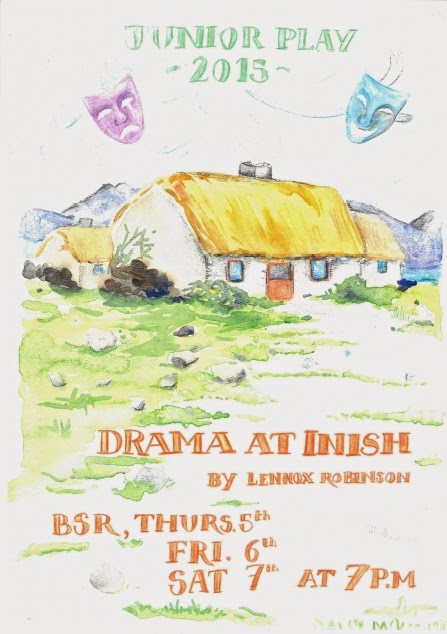
'Drama at Inish'

Poster by Daisy McKeever

The 2015 Junior Play is on this weekend, on Friday and Saturday at 7pm in the Big Schoolroom. It's Lennox Robinson's old favourite, Drama at Inish (last produced here in 2001 as the Senior Play). All parents and their guests are welcome. 

Here is the programme:

"Everyone needs some entertainment while on holidays but when the de la Mare Reparatory Company comes to Inish for the summer season no one expects the response they will engender in the locals…

Lennox Robinson is a much-loved Irish playwright who was director of the Abbey theatre for many years. Drama at Inish was first performed in 1933. It has been produced in America several times under the title Is Life Worth Living?

There are three Acts in the play, with two scenes in Act II.  The action takes place in a private sitting room of the Seaview Hotel, Inish.


ACT I: A July morning.

ACT II: Scene i & scene ii – Early evening, ten days later.

ACT III: A week later, morning.

The Players
John Twohig, proprietor of the Seaview Hotel:  Nevin McCone
Annie Twohig, his wife:  Nicole Dickerson
Lizzie, his sister:  Alexandra Murray-Donaldson
Eddie Twohig, his son:  James O’Connor
Peter Hurley, the local T.D.:  Douglas Boyd Crotty
Christine Lambert: Lena Pirlet
Hector de la Mare, an actor:  Ross Magill
Constance Constantia, his wife:  Emmanuella Ejase-Tobrise
Helena:  Grace Goulding
Michael:  Max Hillery
Jean Hegarty, a report:  Aniko Szkendy
Deirdre Mooney, a Guard: Isabelle Townshend
Slattery:  Catherine Butt

Production Credits
Make-up: Helena Gromotka, Ciana Taylor, Marie-Sophie Stumm
Poster:  Daisy McKeever
Willing Helpers:  MJ McCullough, Robbie McDonald
Costumes:  Karen Hennessey, Evan Jameson & Ronan Swift


Lights, Sound, Set, Props and Direction: Evan Jameson & Ronan Swift

Monday, October 13, 2014

Bullying Awareness Week

This is Bullying Awareness Week in the College. For more details, see the College site here.

A video shown this morning at Assembly to introduce the topic was about words, and the language we use to and about each other. Since English is all about language, and the best choice of words, it seems right to post the video on this site, too.

Monday, June 09, 2014

Voices of Poetry 2014

The annual Voices of Poetry evening, one of the highlights of each year's weekend events, took place on the evening of Sunday 25th May, again expertly marshalled and presented by Mr Swift. 

The first reading, in English, was by Eleanor Moffitt, of Ifueko Bello-Asemota's poem 'Chibok', about the recent kidnappings in Nigeria, followed by Ugo Onwurah's excellent rendition of a pidgin English poem from the same country. We then zoomed over to Scandinavia with pieces from Louvisa Karlsson-Smthye (Swedish) and Nora Langguth (Norwegian) and continued on the Northern European theme with our staff visitor from the Netherlands Daan Dirksen, and a poem in German by Goethe, 'The Stolen Child', from Alanna Kerr (who leaves us this term). From the English Department, Ms Duggan went for Frank O'Hara's 'Animals'.

Some exotic locations followed: Ukraine (Anton Lysenko), Russia (Roman Sharykin) and Armenia (Kristina Danielyan), followed by a first - Farsi read by MJ McMullough.  The originator of the whole concept, our former Head of English John Fanagan, then gave a brief account of the reasons he had started Voices of Poetry many moons ago after experiencing a similar event at the University of Exeter International Summer School and read Seamus Heaney's fine sestina (which you can hear the poet himself reading at the following link) 'Two Lorries'. More English followed: Nyla Jamieson with her Junior Poetry Prize winner 'The Tear', and James O'Connor with the poem he recited at this year's Poetry Aloud competition, Robert Frost's 'Stopping by Woods on a Snowy Evening'.

We moved back into non-English languages then, with Siobhan Brady (Irish), Nicholas Russell (Italian), French (Valentina Ascensio Munoz), Catalan (Laia Casas Abella), Indonesian (Aisha Burke), Korean (Sun Woo Park) and Cantonese (Tim Cheng).

The final group consisted of four leavers: our retiring Head of Geography, 'Ted' Sherwood, with Yeats's 'The Fisherman', a poem which, he said, has pursued him throughout his years in education, the Senior Prefect Alex Owens (Carol Ann Duffy's 'Valentine'), the winner of the Peter Dix Memorial Prize for Poetry (Sadhbh Sheeran, for the third year in a row, with 'The Blight of Sunday Mass') and lastly Mantak Suen, with a memorable impact in Mandarin.

Many thanks to Mr Swift and all the readers for another lovely evening.

Friday, December 06, 2013

Launch of the new 'Portrait' of SCC

Last night saw the launch of the fine new edition of A Portrait of St Columba's College 1843-2013 by Patrick Wyse Jackson and Ninian Falkiner, published by the Old Columban Society. The first edition went up to 1993, and Ninian Falkiner has now updated it with 50 extra pages of photographs and text.

The result is a very handsome volume of fascinating photographs of the College from its earliest years to 2013, with accompanying text. The new supplement includes much material on sport, drama, new developments such as the Library, the Sports Hall and the Cadogan Music Centre, and features on prominent academic and non-academic staff such as Patrick Gray, Bud McMullen, Peter Kielty and Jimmy O'Connor. Page 47 has a striking photograph by Peter Watts of many of the small children of the teaching staff of the school, who in recent years have contributed to the distinctively family atmosphere on campus. The new pages also frequently refer to the College's first-ever independent assessment last year through the extremely positive Whole School Evaluation by the Inspectorate of the Department of Education and Skills.

Last night guests gathered in Whitehall to be welcomed by the Warden, who paid tribute to the editors for their initial project, and to Ninian's dedication, meticulous attention to detail, and hard work in putting together the new book. He also welcomed Professor David Dickson (Old Columban, 1960-65), Associate Professor of History at Trinity College, Dublin, who formally launched it.

In his comments, Professor Dickson said that a strong sense of place struck him on reading the book, of the place that had been the College's home since 1849, and also that the College was pretty much the same age as photography itself. Some of his favourite photographs were striking ones of the former Chaplain, Bert Walsh, preaching in Chapel (page 122, in 1988), of the former Sub-Warden, Norman Lush, at the reopening of the cricket pavilion (page 38, 2010) and especially of the staff in 1959 (page 95), a small and hugely talented group of men who were very very good teachers and, as has been throughout the College's history, were educators who left a permanent influence on so many pupils. Did the teachers make the place, or has perhaps the place itself made these teachers through the ages? He ended with an appeal for photographs and their 'meta-data' to be preserved digitally in the future.

Ninian Falkiner then voiced his appreciation to all for coming to support the venture - a real gathering of the Columban community. He said that the College and the Old Columban Society had always had a close and happy bond, and this was plainly still the case, especially in the complete support the Warden and Sub-Warden had given him. He thanked the latter, John Fanagan, several members of staff, and especially Peter Watts for his photographic expertise, as well as Robert Doyle of the printers A.D.&D. He reminded all that profits will go to the Bursary Fund of the Society, and help the children of Old Columbans attend the College, and concluded by thanking his original co-editor, Patrick Wyse Jackson, and stating, once again, 'Floreat Columba et Floreant Columbanenses.'

Copies of the book can be purchased from the College Office at €20 each.


Pictured: Professor David Dickson, Ninian Falkiner, Patrick Wyse Jackson, Warden Lindsay Haslett.

Sunday, November 17, 2013

Review of 'An Inspector Calls'

On Thursday, Friday and Saturday we saw the excellent Senior Play production of J.B. Priestley's 'An Inspector Calls'. Here Sofia McConnell from Fifth Form gives her account of the play:


The play starts in Brumley, North England, in the home of a rich industrialist. It is a spring evening in 1912 and the Birling family have just risen from a comfortable family meal, celebrating the engagement of their daughter, Sheila, to Mr. Gerald Croft. The lights shine onto a small set. Four straight-back chairs surround a coffee table in the foreground; to the left there is a large armchair under a lamp. At the back of the stage there is another table, on it a collection of old, leather-bound books and an assortment of drinks. Enter stage right, Sheila (Siobhan Brady) and her young, wild brother, Eric (Sam Clarke), talking, laughing and drinking. They are soon followed by the rest of the party; Arthur and Sybil Birling (Mark McAuley and Gabriella Masding) and Gerald Croft (Aidan Chisholm). Once they are all seated and happily talking, the maid, Edna, (Lydia Johnson) brings in a round of port to finish off a successful evening. So all is well in the Birling household.

A short while later, the bell rings. Edna announces the arrival of an Inspector Goole (Mark Russell). He is here to investigate a suicide case. The suicide of a young, pretty, working class girl, Eva Smith, who killed herself by drinking strong disinfectant. As the plot progresses and thickens the audience is captured up in twist after turn of the inspector’s vigorous questioning. We learn of her previous employment and dismissal at Birling’s factory, of Sheila’s upset at a clothes shop where Eva had found work, which results in Eva being fired again, of Gerald’s “helping hand” once Eva (after changing her name to Daisy Renton), has been reduced to a “different kind of life”. Next to be revealed is Mrs Birling’s prejudiced refusal to give help to Eva from the charity committee of which she was president, simply because the girl, in her desperation, lied about her name and situation. Finally the horrifying truth of Eric’s drunken nights about the town comes out, how he made the same girl pregnant and stole money from his father to support her. The audience watches, helplessly, as Inspector Goole rips apart any walls, any confidence or comfort that this family has established. They fall into disarray, quarrelling, shouting, crying and lapsing into utter despair.

After the inspector has left, Gerald suddenly has an idea that they have been fooled. All expectations are raised suddenly as the inspector turns out to be a fraud. They see a hole through his questioning. What if they’re not all talking about the same girl? What if the “inspector” was pulling their leg and making them believe a collection of girls was actually only one girl. When they call the infirmary and ask about the arrival of a suicide victim that afternoon they are relieved to hear that there was none. All but Sheila and Eric, who are still appalled at all the horrifying truths that have come out, laugh and smile. It seems that, although all is not as it had seemed an hour ago, and although Sheila has broken off (for now) her engagement to Gerald and it seems as if life can go on in the Birling house without public scandal. Suddenly the phone rings. Silence falls on everyone in the room. You could hear a pin drop in the audience. Arthur walks slowly towards the telephone and raises it to his ear. A girl has arrived at the infirmary. A suicide victim, she swallowed a strong disinfectant. A police officer is on his way to ask some questions. All hope is shattered.

The cast were all brilliant and never lost character for a moment. I believe Mark Russell (the inspector) deserves huge praise for his outstanding performance, but huge effort was put in from every one of them and it all paid off. Mr McCarthy and Mr Swift produced an amazing play and so a big thank you to both of them. Overall I think the play was a great success. The whole audience was enraptured from start to end and, when asking people what they thought of the play as they were leaving, one parent told me it was the “greatest, most thrilling performance I have seen in St Columba’s yet.”

Thursday, November 14, 2013

An Inspector Calls

Tonight sees the preview of this year's Senior Play, J.B. Priestley's An Inspector Calls, directed by Mr Peter McCarthy. Rehearsals have been under way since near the start of term.

In this classic drama of mystery and shared responsibilities a small cast is asked to give intense performances over three acts. The play, to be performed on three sides, is set in the early part of the 20th century on a night of self-satisfied celebration for one wealthy family. But not all is rosy in the Birling household...

The first performance proper is in the BSR on Friday 15th November, at 7pm, and the second performance the following evening - same time, same place. All parents and their guests are most welcome.


(Poster by Molly Dunne)

Friday, October 18, 2013

Transition Year House Speech competition, 2013

On Sunday 29th September we had the annual Transition Year House Speech competition in the Big Schoolroom. Now we have a very thorough review of the speeches and the evening by TY pupil Louvisa Karlsson-Smythe.

As she writes: All in all, the house speech competition  was truly a wonderful night. From touching, heart-wrenching speeches to ones which made us cry with laughter, that night, we had it all. The wide variety of subjects chosen by the pupils gave an interesting mix to the whole evening, which I will do my best to review in the following lines.

Read Louvisa's full review here.

Wednesday, May 29, 2013

Junior Public Speaking Competition 2013

Each year we prepare II formers for the Junior Public Speaking competition. Here's a report from the College website about last Saturday's event:

"Last Saturday saw the ninth annual public speaking competition for II form take place in the Cadogan. There were a record number of speakers - thirteen in all delivering speeches on a topic of their choice before an audience of the Junior members of the College. The standard of speeches was possibly the highest ever and it is eloquent testimony to the skill of the English Staff in preparing their pupils as well the confidence and ability of the pupils themselves. The pupils are given a very short time to prepare their speeches and then invited to volunteer for the event. The speeches ranged from the comic to the serious, the personal to the academic, the light-hearted to the challenging.

There were some excellent speeches and special mention should be given to Helena Gromotka's bravura speech on her family which was delivered entirely without notes as was Jack Stokes's very moving speech on his grandfather which elicited great applause. Douglas Boyd Crotty and Blanaid Sheeran gave very good comic speeches which were both amusing and well-paced. Emmanuella Ejase-Tobrise was the runner-up speaking on the subject of Women's Rights. The winner was Freddie de Montfort who gave a speech on a historical theme - 'The Hassassins' (an Islamic sect operating in the Middle East as the time of Crusades). Freddie was able to demonstrate clear knowledge and passion for his subject and we all learned something about the subject on that evening. Congratulations to all those who participated in a very successful evening."

Wednesday, February 06, 2013

Twelve Angry Jurors

Last weekend saw the two performances of the annual Junior Play, this time Twelve Angry Jurors (adapted from the original 'Men' and best known for the film version featuring Henry Fonda) by Reginald Rose. Here, Ally Boyd Crotty from Transition Year reviews the production:-


On Friday 1st and Saturday 2nd February a cast of eleven Transition Year pupils and three third formers performed a thoroughly rehearsed play called Twelve Angry Jurors. The play was presented in three acts, and was excellently directed and produced by Mr. Swift.
     
Before the play had even begun the unusual and intimate layout caught everyone's attention - in the middle of the BSR (instead of on a raised stage) was a table around which the audience sat in tiers. This meant that everyone felt more involved, and this layout also resulted in everyone being able to see properly.

The play was about a nineteen-year-old boy on trial for murder. It followed the decisions of the jury involved in the case. When the jury first began their discussions at the beginning of the play, they first decided to see where they stood by taking a vote. The vote stood at eleven to one - eleven voting that the boy was guilty. Only one voted not guilty, and this was jury number 8, played by Christian McKeever.
       
For the remainder of the play we tracked the jury proceedings, and watched as the eleven jury members gradually began to be convinced by number 8 that the boy was not guilty, until finally Alex Barnes-Auld cracked and the boy was acquitted. The tension was cranked up skilfully, as the actors revealed the motives and attitudes behind each juror’s decision-making. Eireann Tinkhof, Alex Barnes-Auld, Iyobosa Bello-Asemota, Jamie Maher, Eliza Hancock, Nadia Al Lahiq, Oisin Large, Arthur Moffitt, Alina Stiehler and Muqtadir Shah performed the parts of the other jury members, while the foreperson of the jury was Celine Klee. Eleanor Moffitt and Janet Boyd played the parts the judge and court clerk.

The standard of acting by all members of the cast in my opinion was extremely high, everyone stayed in character and there were no errors to be seen. This production got an extremely good reaction by everyone who was fortunate to have been able to see it, and I would say it was very successful.

Tuesday, November 27, 2012

'Fiddler on the Roof' review

Alex Owens of V form here reviews the recent College musical Fiddler on the Roof:

On the 17th November the SCC Drama Department presented their final performance of this year’s college musical: Fiddler on the Roof. After months of hard work, starting back at the end of June when final casting was drawn up, and scripts  given out for learning over the summer, the production was completed and  staged in the BSR over three nights. 

The play itself is based on a novel by Joseph Stein, set in a small village known as Anatevka in 1905 before the Russian Revolution.  The story revolves around the main character Tevye played by the very talented Zachary Stephenson. Tevye is a father of five daughters and the story shows his attempts to maintain Jewish religious traditions and support his family.
    

We see how Tevye copes with his three eldest daughters taking their own choice of husband, slipping further away from him and his faith. He also has to listen and take advice from his sharp-tongued wife Golde, played by the accomplished Siobhan Brady.  

The evening opened with the Fiddler’s signature song ‘Tradition’, which is the main idea which the story is centred around, sung by the entire cast. Also accompanying the cast was pianist Margaret O’Sullivan Farrell and violinist Mary Fitzgerald, brought in especially for the performances by musical director Geraldine Malone Brady. However much more was to come throughout the night with many more numbers such as ‘Matchmaker’ sung beautifully by the three eldest daughters Sally Beeby, Molly Buckingham and Pia Gromotka. Following that, we heard a fine performance of ‘If I were a Rich Man’, sung powerfully by none other than the star of the show, Zach Stephenson and other solo parts with excellent singing by Arthur Moffitt, Sinead Alari, Siobhan Brady, Mark Russell and Mark McAuley. For the musical finale we had the mournful patriotic number ‘Anatevka’ sung by the entire cast.  

The use of light to depict the mood proved to be very effective against the minimalistic background. But the costumes without a doubt took centre stage in being a key role and completing the look of the whole performance, all of which were hand-picked carefully and created by Costume Director Karen Hennessey. In terms of the acting quality of the play, none of this would have been possible without the direction and encouragement of the head of Drama Mr Swift, and special thanks must go to Mrs Malone Brady for her superb musical contribution and coaching of such a large cast.

Overall it is quite clear that this was another enormously successful production from the Drama Department, displaying top-quality performances containing pupils from different year groups throughout the school and they should be commended for their hard work and devotion to a magnificent end result.


Click here  for a photo slideshow of the production.