We head off today on our Easter holidays. A good thing for Seniors to do over the coming weeks is to compose entries for the Peter Dix Memorial Prize for Poetry. The rubric is below:-
All entries are to be typed and sent to Mr.Canning at lcanning@staff.stcolumbas.ie by the evening of Thursday 22nd May.
Entries should contain a portfolio of between two and five poems based on or inspired by the idea of either:- PLACE or PEOPLE or PROMISES.
Poems should be at least ten lines long, and typed. The winning entry will be based on the overall standard of the entrant’s body of poems. There will also be a prize for the BEST POEM if it is not in the winner’s selection. All other strong entries will be posted on www.sccenglish.ie
The English Department will also give smaller book-tokens to strong entries that do not win the Prize.
You can treat the ideas, ‘Place’, or ‘People’ or ‘Promises’ in a free way: any connection is fine, as long as the poems are clearly connected by image, inspiration, theme, form, situation, context …
The Peter Dix Memorial Prize for Poetry was presented by the Dix family in memory of Peter, who died in the Lockerbie tragedy in 1988. The Memorial, by sculptor Joe Sloan, is kept in the Library
and inscribed with the names of past winners.
The next choice for the SCC Book Club is I Am Malala
by Malala Yousafzai. We will be meeting to discuss it late in the
summer term. The book is available in your local library, the school
library, bookshops or on an e-reader.
When the Taliban took control of the Swat Valley in Pakistan, one
girl spoke out. Malala Yousafzai refused to be silenced and fought for
her right to an education.
On Tuesday, October 9, 2012, when
she was fifteen, she almost paid the ultimate price. She was shot in the
head at point-blank range while riding the bus home from school, and
few expected her to survive.
Instead, Malala's miraculous
recovery has taken her on an extraordinary journey from a remote valley
in northern Pakistan to the halls of the United Nations in New York. At
sixteen, she has become a global symbol of peaceful protest and the
youngest-ever Nobel Peace Prize laureate.
In her Transition Year Extended Essay this year, Ciara Dempsey gained a distinction for her writing on 'The Consequences of Love', comparing two novels - Arthur Golden's Memoirs of A Geisha and George Orwell's 1984 - and two plays: Arthur Miller's All My Sons and Shakespeare's Romeo and Juliet.
Ciara writes:
"I hoped that with these stories I would be able to view as many different kinds of love as possible, to give me a better amount to compare, which I guess should have made it easier. The reason I chose this topic is really quite simple, I thought it would be easy. Unfortunately for me I found that not to be the case. That’s not to say that the topic has to be hard, but I know I personally found it difficult to write anything for it. However, in the end I hope it has all come together to be enjoyable for you to read."
Read the full essay here.
Many congratulations to III former Nyla Jamieson, who has been shortlisted in the Junior category of the Eason Creates Creative Writing competition. Her story, along with 8 others, will shortly be published on www.easonedition.com, and the overall winner will be selected by a combined public and judge-based vote.
An article worth reading by V formers, who are currently studying Antigone as part of their comparative course. In the Guardian, Natalie Haynes writes:
"If the theme of Oedipus is seeing and blindness (the great irony of the play is that only when he is blinded can Oedipus truly see who he is and what he has done), the theme of Antigone is knowledge and certainty. Everyone knows that what they do is the right thing, and yet it ends in disaster."
Read the full article, "Antigone - freedom fighter or terrorist", here.
Watch ShowMe analysis of
The ending of the novel:
http://www.sccenglish.ie/2012/03/great-gatsby-15-end-of-novel.html
- ‘I found myself on Gatsby’ side, and alone.’ p.141. How is this so for Nick following Gatsby’s death?
- What do we learn about Gatsby’s background from seeing his father (pp 144-150).
- What are Nick’s feelings as he finally leaves Jordan Baker? (pp. 152-153)
- What are Nick’s feelings at and after his last meeting with Tom Buchanan? (pp153-4).
- Choose three phrases/quotations from the last 25 lines of the book, and accompany each with a short explanation of its importance/significance.
The Guardian has a short film called The Departure on its website (see it below), featuring Gillian Anderson, who played Blanche Dubois in the Young Vic's 2014 production of A Streetcar Named Desire. It is set just before Blanche travels to stay with Stella in New Orleans. Here are Anderson's comments.
We study Streetcar in Transition Year in the summer term: good material for discussion here.
The latest edition of our Library magazine, The Submarine, has just been published, and can be read above via Issuu (click once for a closer look, click again for still closer, and use the arrows for navigation).
This time: interesting comments by the editor and Librarian, Mr McConville, about digital technology; a report by Seyilogo Braithwaite on the visit by novelist Paul Murray; news of the forthcoming Arts Week; Gabriel Chisholm on 'Snakes', book reviews by Nyla Jamieson, Dr Bannister and Mr Swift; Valentina Ascencio Munoz on the benefits of literature; Blanaid Sheeran on the Book Club set up by Mr Jameson, and more.
The theme for this year's Junior Poetry Prize is 'The Senses' (sight, hearing, smell, touch, taste).
Any interpretation of this theme is welcome. Poems should be twelve lines or more, and each entrant may enter as many poems as he/she wishes. Email your entries to Ms Smith, or hand them to your English teacher, by Thursday 26th March (the day before the end of term).
Watch ShowMe analyses of-
a) Gatsby falls in love with Daisy (p.128) -
http://www.sccenglish.ie/2012/03/great-gatsby-13-gatsby-falls-in-love.html
b) Nick and Gatsby’s last meeting (p.133) -
http://www.sccenglish.ie/2012/03/great-gatsby-14-nick-and-gatsbys-last.html
- Explain how Gatsby ‘found that he had committed himself to the following of a grail’ (p.129) in pursuing Daisy.
- What is the significance of the weather in this chapter? Give details.
- What are Nick’s feelings on leaving Gatsby (refer also to his call from Jordan Baker)?
- (p.139) What are the most significant things about the description of Gatsby’s death?
- If you had to choose one short passage (c.20 lines) as the key one in this chapter, what would it be? Why? Key quotations?
- Three other useful quotations from the chapter not used already.
The Poem for Ireland microsite from RTE is nicely done, with the texts of the shortlisted poems, comments on them, background, recitals from Poetry Aloud finalists, and the ability to upload material, including performances of the poems. And, of course, the facility to vote for your favourite poem.
Here's Patrick Kavanagh's 'A Christmas Childhood'.
A reminder to TY pupils that a poem can be part of this year's Work Portfolio (possibly a response to one of those on the shortlist).
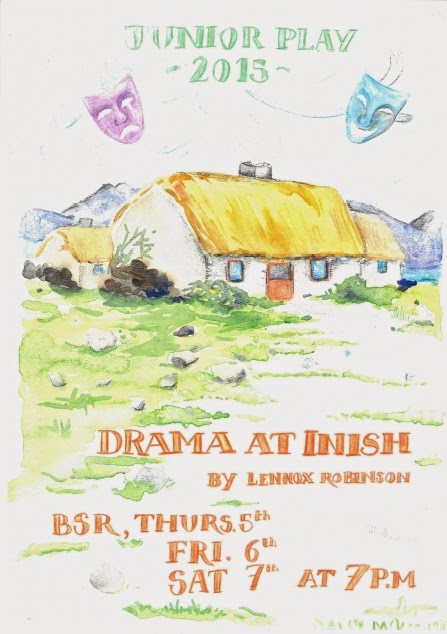 |
| Poster by Daisy McKeever |
The 2015 Junior Play is on this weekend, on Friday and Saturday at 7pm in the Big Schoolroom. It's Lennox Robinson's old favourite, Drama at Inish (last produced here in 2001 as the Senior Play). All parents and their guests are welcome.
Here is the programme:
"Everyone needs some entertainment while on holidays but when the de la Mare Reparatory Company comes to Inish for the summer season no one expects the response they will engender in the locals…
Lennox Robinson is a much-loved Irish playwright who was director of the Abbey theatre for many years. Drama at Inish was first performed in 1933. It has been produced in America several times under the title Is Life Worth Living?
There are three Acts in the play, with two scenes in Act II. The action takes place in a private sitting room of the Seaview Hotel, Inish.
ACT I: A July morning.
ACT II: Scene i & scene ii – Early evening, ten days later.
ACT III: A week later, morning.
The Players
John Twohig, proprietor of the Seaview Hotel: Nevin McCone
Annie Twohig, his wife: Nicole Dickerson
Lizzie, his sister: Alexandra Murray-Donaldson
Eddie Twohig, his son: James O’Connor
Peter Hurley, the local T.D.: Douglas Boyd Crotty
Christine Lambert: Lena Pirlet
Hector de la Mare, an actor: Ross Magill
Constance Constantia, his wife: Emmanuella Ejase-Tobrise
Helena: Grace Goulding
Michael: Max Hillery
Jean Hegarty, a report: Aniko Szkendy
Deirdre Mooney, a Guard: Isabelle Townshend
Slattery: Catherine Butt
Production Credits
Make-up: Helena Gromotka, Ciana Taylor, Marie-Sophie Stumm
Poster: Daisy McKeever
Willing Helpers: MJ McCullough, Robbie McDonald
Costumes: Karen Hennessey, Evan Jameson & Ronan Swift
Lights, Sound, Set, Props and Direction: Evan Jameson & Ronan Swift
Watch ShowMe analysis of
‘Daisy and Gatsby meet again’ -
http://www.sccenglish.ie/2012/02/great-gatsby-7-gatsby-daisy-meet-again.html
- What is the nature of the meeting between Gatsby and Daisy in Nick’s house (before Nick leaves)? (Heinemann pp74-76).
- What is the nature of the meeting between Gatsby and Daisy when they move to Gatsby’s house?
- What is the significance of the green light at the end of the dock? (refer to the rest of the novel, too).
- In what ways are dreams important in the novel?
- If you had to choose one short passage (c.20 lines) as the key one in this chapter, what would it be? Why? Key quotations?
- Three other useful quotations from the chapter not used already.
(no ShowMe analyses from this Chapter: the next one will be from Chapter 5, ‘Daisy and Gatsby meet again’ - http://www.sccenglish.ie/2012/02/great-gatsby-7-gatsby-daisy-meet-again.html )
- What are Nick’s reactions to the stories Gatsby tells him about his past? [pp 57-59, Heinemann]
- Three useful quotations from those pages (above).
- Significant details about Meyer Wolfsheim.
- What is the significance of the references to the World Series fixing of 1919?
- What do we (and Nick) learn from Jordan Baker about the origins of Daisy and Gatsby’s relationship?
- If you had to choose one short passage (c.20 lines) as the key one in this chapter, what would it be? Why? Key quotations?


